Bold Moves, Big Goals: Whitman Launches Transformation 2030 Plan to Become a Top 25 Undergraduate Business School Within Five Years
Key Elements of Transformation 2030:
- Elevating the academic and student experience to ensure a culture of teaching excellence and emphasizing relevant skills for career preparation, including infusing AI and emerging technologies into the classroom and increasing support for students in need.
- Investing and growing Career Services, allowing for expanding of tools, resources and use of technology for internship and job search at top companies like Goldman Sachs, Amazon and Google.
- Expanding experiential learning and programs throughout the entire Whitman experience. This includes career exploration trips, study away programs, certifications and competitions, projects, simulations, and use of VR and other technology.
- Extending Whitman’s geographic reach to untapped student populations beyond the northeast.
- Elevating the brand and reputation of the Whitman School and fully aligning the advancement, alumni engagement, and marketing and communications teams, improving social media storytelling, and showcasing the thought leadership of the faculty.
- Enhancing the facility and learning environment to support student learning and strategically using space to support operations.
- Diversifying Whitman’s revenue streams beyond undergraduate tuition.
- Creating best-in-class alumni and donor engagement strategies including creating the Whitman Leadership Circle to recognize outstanding generosity, and the Parents Advisory Council to expand the Whitman network and support.
When the Whitman School of Management welcomed members of the Class of2029 to campus this fall, it was greeting the most academically qualified and well-rounded group of undergraduates Whitman has enrolled to date, according to Syracuse University Vice Chancellor for Strategic Initiatives and Innovation and Executive Dean of the Whitman School J. Michael Haynie.
“This cohort of students is symbolic of the direction to come for Whitman between now and 2030,” says Haynie. “As a group, they are not only the most academically qualified but also a great balance of those who were team captains, club leaders, military veterans, budding entrepreneurs and more—a fantastic testament to the effort the Whitman School is undertaking to make ourselves a top 25 ranked undergraduate business school by 2030.”
Called Transformation 2030: Ascending to Excellence in Business Education at Whitman, this initiative is a hard and fast commitment to reaching this goal. “It’s more than just a traditional five-year strategic plan that every school puts out as a guideline,” says Haynie, who joined Whitman in 2023 as executive dean, in part, to focus on raising the school’s profile with the full support of the Chancellor’s Office.
“It’s a line in the sand that is sending a signal both internally and externally that we are going to be doing things differently at the Whitman School. We intend to go from good to great. And we’re being very transparent about our intentions in order to get everyone on board, while also holding ourselves accountable,” says Haynie.
Haynie makes it clear that Transformation 2030 is about far more than a ranking. “Being in the top 25 is a tangible milestone that is part of a larger goal to deliver world-class educational outcomes for our students,” he says.
Whitman Interim Dean Alex McKelvie agrees. “You achieve a goal by putting it out there and talking about it,” he says. “Our students, staff and faculty know what we intend to do, but we’re also making sure that our alumni, corporate partners and, of course, prospective students and families and the greater community also are aware.”
The Whitman School has been on an upward trajectory both in rankings and the excellent academic experience it offers for a number of years, receiving student applications in record numbers for four years in a row. This fall’s class of first-year students saw nearly 8,600 applications for a cohort of 573, many more students than Whitman was expecting and the second largest incoming class ever.
“That’s 16 applications per available slot, which makes us the most in-demand school on campus,” says McKelvie, noting that Whitman had the second highest number of applications of the University’s 13 schools behind only the College of Arts and Sciences.
In addition, Whitman enrolled approximately 100 students transferring from other schools and colleges within Syracuse University and 25 external transfer students. Whitman is the fastest growing school on campus with an 11% increase in applications.Whitman is drawing record numbers at a time when colleges, particularly those in the Northeast, are being impacted by the “demographic cliff.” This term refers to the decline in high school graduates and college-bound students beginning in 2025 as a result of declining birth rates recorded after the 2008 Great Recession. The decline is expected to continue for the next several decades, which may lead to fewer qualified applications, lower enrollment, decreased demand for some majors and, as recent headlines have shown, the closure of some institutions, particularly smaller colleges.
Syracuse University, along with all the colleges and schools in this region, will have to work that much harder to attract and retain the best students. And while business schools remain highly sought after, that does not mean that Whitman’s student numbers could not decline, further emphasizing the need for Transformation 2030 to be successful.
“The top students out there are going to have a lot of excellent choices in the years ahead, and that is part of the reason we are undertaking Transformation 2030,” says McKelvie. “Business is the fastest growing area of higher education right now, particularly since the COVID pandemic, and that’s not lost on us, but it’s not lost on our competitors, either.”
A smaller pool to pull from makes it essential to ensure that high-achieving students and their families see and hear the success stories coming out of Whitman related to career and internship opportunities, the variety of majors offered, quality of faculty, alumni engagement and networking, experiential learning and merit scholarships, as well as funding to cover expenses that ensure that all students are getting an equitable experience.
Of course, an initiative of this size cannot be accomplished in a bubble. According to Haynie, Transformation 2030 has the full support of the Syracuse University Chancellor’s Office and senior leadership.
“We need the backing of the entire University to make this happen,” says Haynie. “Whitman’s success will also be Syracuse University’s success, as having a top 25 ranked business school will be a positive for the entire University.” “We need the backing of the entire University to make this happen.
Whitman’s leadership has established metrics to show progress as it works toward its 2030 goals. “As a business school, we are practicing what we preach, and the proof will be in the data,” says McKelvie. “This is going to be an open and transparent process. We know that some things won’t work out exactly as planned, but I’m confident most will. And like any good business, we will also be prepared to adapt and pivot as we learn from our efforts and see results that will ultimately achieve this herculean but obtainable success.”
PROFILE OF THE CLASS OF 2029
APPLICATIONS: 8,596 (exceeding prior high of 7,833)
NUMBER ENROLLED: 573
AVG. SAT: 1349 (highest ever recorded)
AVG. ACT: 31 (highest ever recorded)
GPA: 3.84 (highest ever recorded)
What Determines Rankings?
A number of factors go into a college ranking, which are determined by organizations using methodologies that combine data, as well as surveys to evaluate universities on various weighted elements.
Whitman is gauging its success in reaching the top 25 from the highly respected Poets&Quants, a global media company and leading source of rankings, news and analysis for business programs.
“Poets&Quants bases its rankings on three equally weighted categories: admissions, student experience and job placement,” says McKelvie. “The benefits relative to other rankings are the simplicity and alignment of what we value and what Poets&Quants values.”
The Whitman School was ranked #39 in the 2025 Poets&Quants Best Undergraduate Business Programs in the U.S.
Extending Its Geographic Reach to Find New Student Populations
In response to the demographic cliff, the Whitman School has developed strategies to extend its reach into regions not experiencing a decline in student population. Whitman traditionally draws from the Tri-State area and throughout the Northeast. New locations identified, for example, are Georgia and parts of the Southwest, where the Whitman School has had strong interest in the past, as well as the Washington, D.C., area, where the Syracuse University Center is an established presence.
“We are being very strategic in our recruiting efforts. Of course, we will continue to market Whitman in the places where we know we already have solid brand recognition and a strong alumni base, but we’re also working on creating a stronger physical and digital footprint in places that the data shows have a larger population of students headed to college in the next decade,” says Lindsay Quilty, assistant dean of academic programs and student success.
Quilty notes that Whitman will continue to tell the story of its success both in traditional markets and areas targeted as potential markets around the country. As a school and a University, the proximity to New York City and the opportunities available to students and graduates are a big draw. And Whitman will continue to use that to its advantage to market to those in other parts of the country who want a taste of living and working in New York City.
This will happen both through physical and digital outreach, including digital advertising, targeted social media campaigns that highlight events and share a day in the life of a Whitman student, as well as more robust digital tours of the campus so students unable to access campus can get a realistic overview of the sights, sounds and excitement of Syracuse University and the Whitman School.
Incentivizing High-Achieving Students to Stay
Of course, getting students to apply to the Whitman School is only a piece of the puzzle. Once students are accepted, the real work begins in getting them to choose Whitman and stay the course for four years.
For example, the newly created D’Aniello Scholarship for Excellence offers an opportunity for those considering enrolling at the Whitman School by offering an elite scholarship for those who not only excel academically but also demonstrate valuable leadership qualities that they are certain to bring to the Whitman community.
According to McKelvie, the process involves assessing as many as 300 prospective students and offering a select group additional merit-based funding (beyond any financial aid packages they receive from the University) to earn their degree at the Whitman School. Last spring, 35 first-year students were offered this opportunity, and 18 enrolled—clearly a win for both the students and the Whitman School, especially given the academic credentials of those students selected.
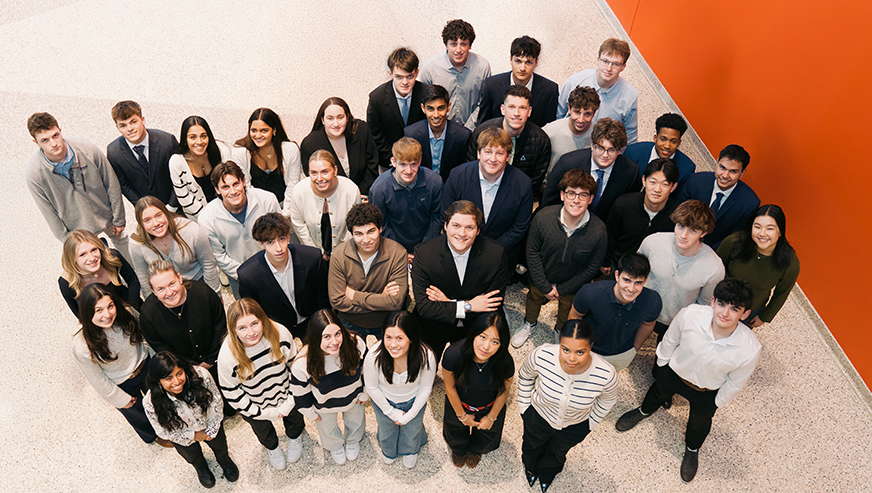
Class of 2028 Barnes Scholars
In addition, Whitman is looking to purposefully retain those students who have demonstrated outstanding academic achievement during their first year but have not necessarily received merit based scholarship funds from Syracuse University. High achieving students are often at risk of being lured away by competing schools with merit scholarships and other incentives after their first year, according to Quilty. However, a new retention scholarship program called the Barnes Scholars allows Whitman to try to thwart that risk.
Fifty students in the Class of 2028 were offered the Barnes Scholarship last year to counteract the risk of them being poached by other business schools. This resulted in 49 choosing to return to Whitman this fall to continue their education and contribute to the vibrancy of the larger school community.
“Both the D’Aniello and Barnes scholarships are initiatives sponsored by dedicated alumni who are using their generosity to help the Whitman School recruit and retain the most academically qualified and accomplished class in the history of the Whitman School,” says Michael Paulus, assistant dean for advancement and external engagement.
Off and Running with AI and Other Emerging Technology
While the Whitman School already has plenty to offer, Transformation 2030 is set to create so much more. Continuing to elevate the experience will impact every student at the Whitman School, whether that be by ensuring they are ready for work upon graduation, particularly in the areas of technology; through strong connections to Whitman alumni and other supporters, and/ or through the ability to understand the career possibilities that await them.
One such initiative that began this fall is a one-credit course, Business and Technology: Foundations for the Future, that emphasizes artificial intelligence (AI). This course is required of all first-year Whitman students to introduce them to AI from the perspective of the professional needs and ethical standards expected in using this technological set of tools in their field.
“AI is impacting the world more quickly than anyone anticipated, so this class is not simply focused on how to use this technology but also demonstrates the changes and influence it is having on business right now,” says Quilty. “Today, it’s AI; tomorrow it could be something else. But we have a responsibility to prepare our students with a working knowledge of AI, as well as the responsibilities that come with it.”
Quilty concedes that AI is going to replace some jobs or skill requirements, but it’s also certain to change the way people work—including for the better— so the Whitman School has the responsibility to teach students how to think critically about AI, use it responsibly and leverage the human skills that will be even more valuable in an AI-driven future. Part of Transformation 2030 is working to give students the technological know-how to present themselves to potential employers with the utmost confidence that they have the skills to use AI and other critical technology.
“We take pride in knowing that we can confidentially say we are prioritizing AI and other technologies to interested students,” Quilty says, noting that many prospective students and parents inquire about AI use when coming to Whitman for a college visit.
In addition to the AI course for first-year students, plans are in the works to develop a signature experiential program for each undergraduate year. Seniors are required to complete their Capstone course, a solidifying experience that sums up four years of learning. However, the goal is to add other types of business industry-ready skills programming for sophomores and juniors as well, possibly related to deeper dives into specific skills relevant.
IMPACT Through New Executive Leadership Speaker Series
Another aspect of a great Whitman education is exposure to highly successful individuals and their own journeys.
Two years ago, the Whitman School started its IMPACT Executive Leadership Speaker Series, which brings C-suite executives and business leaders to participate in a fireside chat-style Q/A with Haynie or McKelvie, followed by questions from students in what has become a standing-room-only audience.
“Students are eager to hear the career paths, obstacles, risks and even failures that the most successful people around have taken to achieve at their level,” says McKelvie. “It shows them that everything is possible, and that one day they, too, could be sitting in that chair addressing the next generation of business students. Access to these high-level professionals is an outstanding opportunity that Whitman will continue to offer its students in order to bolster their enthusiasm about what the future could look like for them.”
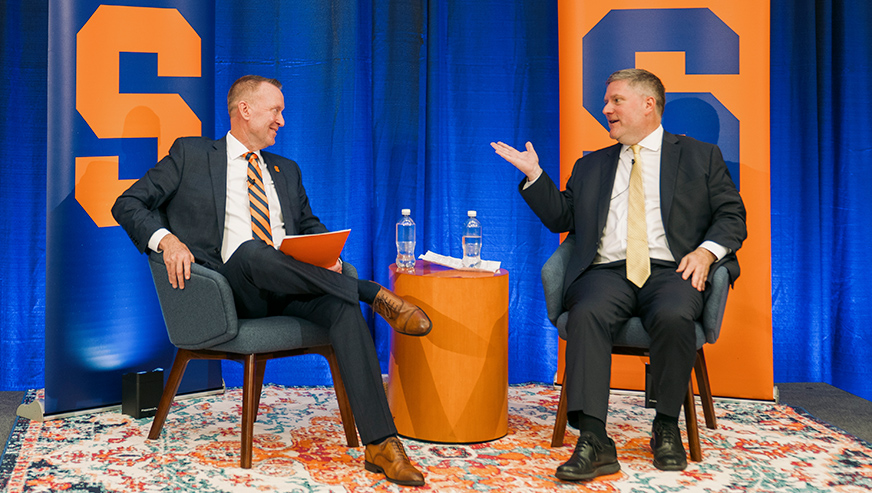
Michael Haynie (left) in fireside chat with Scott Blackburn.
PAST SPEAKERS ADDRESSED STANDING ROOM-ONLY CROWDS
April Arnzen, Executive vice president and chief people officer, Micron Technology
Frank Bisignano P’11, H’17, Former president of Fiserv and current commissioner of the U.S. Social Security Administration
Scott Blackburn, Senior partner and chairman U.S. government, McKinsey & Company
Jim Boeheim ’66 (A&S/MAX), G’73 (MAX), H’24, P’22, P’24, Syracuse men’s basketball coach from 1976-2023 and current special assistant to the Syracuse University athletic director.
Felisha Legette-Jack ’89, Head coach, Syracuse University women’s basketball team
Bruce Mosler, Chairman of global brokerage and the Veterans Initiative Program, Cushman and Wakefield Inc.
Savneet Singh, President and CEO, PAR Technology
Neeraj Tomare, Senior vice president and chief information officer, the Coca-Cola Company
Buddy Valastro P’27, P’29, Celebrity baker of Cake Boss fame, restaurateur, television personality and business owner who turned his family’s business, Carlo’s Bakery, into an empire.
Summer Business Academy Offers Business Minor Differentiating Its Audiences and Offerings
While the Whitman School depends on tuition dollars and support from generous alumni and partners, part of Transformation 2030 is finding new sources of revenue and enabling continued expansion of opportunities for its students.
One source is the establishment of the Whitman Summer Business Academy (SBA), which is targeted to non-Whitman students at Syracuse University who want to add a solid business background to their LinkedIn profile and resume.
Launched during summer 2025, SBA had 115 students enroll for at least one class in its inaugural year. Some participants used the program to earn a business minor (18 credits) over a short period that doesn’t overburden them during the traditional academic year. The SBA’s business minor allows students to complete 15 of the 18 required credits over the University’s two summer sessions. The remaining three credits can be taken during an academic semester or even abroad. This year, the Whitman School offered significant financial grants to kick off the SBA and make it affordable for interested students. The initial popularity of the SBA is a promising road to more opportunities.
Doubling Down on Lessons Learned Outside the Classroom
It is important to remember that some of the critical learning at the Whitman School takes place outside of formal lessons in the classroom. The level of experiential learning has become a differentiator in its degree programs, as the school works to double the number of students participating in this growing array of activities.
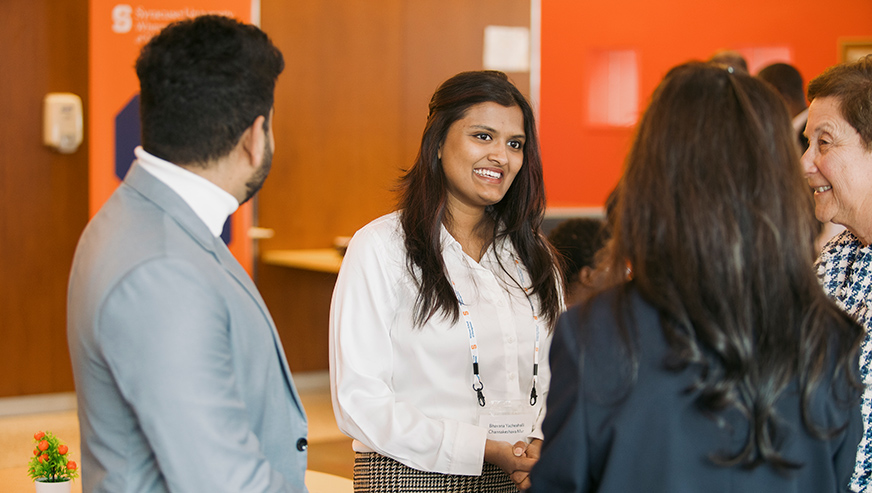
Students networking with alumni during the 2025 Panasci Local Leadership Initiative graduation.
Transformation 2030 involves a commitment to a significant expansion of these opportunities, in number, topics and locations, as well as making sure all students, regardless of major or financial ability, have access to the programs, competitions, career exploration trips and other events and activities that enhance their education and business skills.
According to Erin Draper, director of experiential programs, the Whitman School recently took steps to define what experiential learning means in terms of real-world experiences. The result is defined as learning “gained through active experience rather than passive instruction.”
Having this clear definition of experiential learning, Whitman has begun to specify and organize the skills, knowledge and abilities into what is collectively called the Whitman Mindset.
These competencies have then been organized into four pillars: Be Prepared. Be Collaborative. Be Global. Be Innovative. “The Whitman Mindset is not going to be taught in any single class,” says Draper. “It’s something that will develop over time through participation in high-impact experiential programs offered early and often in a student’s academic career. These are going to be what continues to distinguish our graduates as prepared, global, innovative and collaborative, while pushing our rankings further upward.”
The plan is to create a center that houses most of the experiential learning resources at Whitman. This includes areas like Study Away, the Whitman Industry Readiness & Excellence (WIRE) Initiative, various case competitions, simulations and other industry opportunities. According to Draper, this center is expected to be launched this year and will be housed on the third floor of the Whitman School.
THE WHITMAN MINDSET: FOUR PILLARS FOR SUCCESS
1. BE PREPARED
2. BE COLLABORATIVE
3. BE GLOBAL
4. BE INNOVATIVE
New Experiential Transcripts Help Tell Student Stories
Part of Whitman’s continued expansion of experiential learning will be an effort to record and track the various non-classroom initiatives students participated in during their four years.
Along with their academic transcripts that show classes and grades, students will begin creating experiential transcripts that outline the opportunities taken and the associated skillsets learned.
“Students sometimes struggle to explain how their hands-on experiences connect to the skills employers are looking for. The experiential transcript makes those connections visible, and with support from Career Services, students are learning how to tell that story effectively, so they can clearly articulate the value of the opportunities they’ve embraced and stand out when it matters most,” says Draper.
“In our efforts to reach our top 25 ranking goals, we expect a greater variety of student experiences, meaning more trips, pertinent additions to our Goodman IMPRESS Program, and more funding through the Whitman School and its generous donors to make sure we can provide the best possible experiential learning for our students.”
Business Competitions Prepare Students for the Real-World Shark Tank
Something that creates a lot of excitement are the various competitions held frequently at the Whitman School and at other universities and conferences around the U.S.
Students work together on their own time in teams, often across majors or, sometimes, across other schools and colleges on campus, to compete in areas that encompass entrepreneurship, sustainability, technology and innovation, and real estate. The camaraderie and competitive nature allow students to develop soft skills like public speaking, elevator pitches, leadership, confidence and collaboration, with some competitions resulting in cash prizes and others simply held for the experience and, of course, the bragging rights.
Some competitions held annually at the Whitman School include the Panasci Business Plan Competition, Orange Tank Pitch Competition, the Dean’s SDG Innovation Challenge and the senior year Capstone competition, which showcases examples of what students have learned in their four years of undergraduate education.
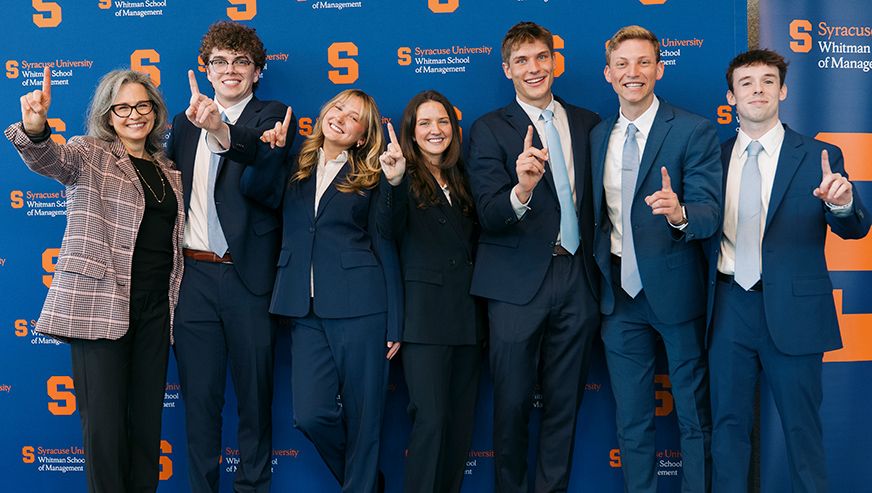
Spring 2025 Capstone winning team Insulitics, consisting of Class of 2025 members Ryan Morash, Emily McClure, Kathryn Proefrock, Adam Best, Evan Kalish and Timothy Cavanagh posing with their mentor Professor of Entrepreneurial Practice Alexandra Kostakis.
During the 2024-25 academic year, another competition was added. The Real Estate Competition for undergraduate students revolved around creating a redevelopment plan for an existing piece of property, taking into account issues of sustainability, environmental impact, zoning, noise and community concerns.
All competitions bring in a variety of alumni judges who are experts in their fields, as well as other corporate supporters, who not only select winners but give valuable feedback to student participants.
“I participated in the Real Estate Competition to challenge myself and apply my accounting skills to a real-world scenario,” says Carly Conway ’25, a member of last year’s winning team. “Being an accounting major gave me an edge because of the broad foundation of our curriculum, specifically, tax and law courses, managerial and financial accounting courses and business formation concepts that set us up to succeed.”
As Transformation 2030 moves forward, the Whitman School will continue to look for additional opportunities of this kind, as well as ways to offset expenses for students and faculty representatives to travel to competitions off site. In addition the Whitman School hopes to attract a greater number of cross-disciplinary alumni to participate as judges and mentors for these competitions.
Whitman Scores With Professionals Sports Collaboration
Another way Whitman plans to diversify its revenue is certain to be a win for the home team, as it has recently committed to a cross-collaboration with Syracuse University’s David B. Falk College of Sport, the S.I. Newhouse School of Public Communications and the College of Professional Studies to offer various degree and business certification options to the Major League Baseball Players Association, the National Hockey League and Major League Soccer.
The initiative will create pathways for current and retired players, their families and team staff to earn online degrees or complete degrees that they never finished due to the demands of their sports careers, as well as certificates and other credentials. It will also allow players to participate in a number of non-credit professional development and executive education training programs, workshops and courses. The program will be tailored to players’ needs and accessible through various formats—online, on-campus or through Syracuse Study Away locations in New York City, Washington, D.C. and Los Angeles.
In addition, the partnership with these organizations will allow Syracuse University students who are interested in sports-related careers to network with those working in the business of sport and have access to internships, projects and even job opportunities.
Exploration Trips Open Students’ Eyes and Company Doors
Another highlight for students is the opportunity to go on career exploration trips to cities like New York and Boston. These short trips, often coordinated or hosted by Whitman alumni and their employers, give students a first-hand look inside companies like Microsoft, Deloitte, EY, Reebok and Converse, as well as the opportunity to interact with C-suite executives and other industry experts.
And, of course, what student doesn’t love the opportunity to learn as they travel around the world. While Whitman students have the chance to participate in Syracuse University’s semester-long Study Abroad programs in various locations globally, the Whitman School has developed several business-specific trips for students that typically take place over spring break, Maymester or the summer.
Last year, Whitman offered three such trips: Business in East Asia, Managing in a Global Setting-Kenya, and Business in Latin America. Business in Latin America, led by Professor of Entrepreneurial Practice John Torrens, focused on business models in the hospitality industry, and included networking with entrepreneurs living and working in Costa Rica. Business in East Asia was a trip to visit 10 major global businesses for an immersive understanding of the economic, geopolitical and cultural aspects of business culture centered in South Korea, led by Associate Professor of Entrepreneurship David Park. Managing in a Global Setting took students to Kenya, led by Assistant Teaching Professor Elizabeth Wimer, and included interaction with women refugees supporting themselves through entrepreneurship.
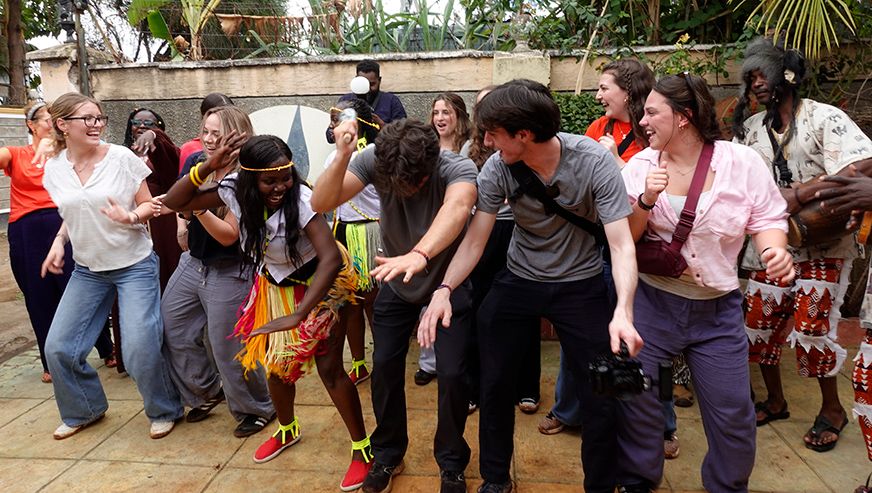
Whitman students dancing with locals in Nairobi, Kenya, spring 2025.
Such trips are typically one to two weeks long and tied to a course at the Whitman School. They include visits with business and community leaders, networking with industry experts, tours of companies and pertinent locations, awareness and practice of business etiquette and cultural practices in different cultures, and of course, some time for sightseeing, delicious food and fun.
Carleton Landingham II ’26 participated in the trip to East Asia and noted that one of the highlights was a visit to Samsung and the Samsung Innovation Museum. “It was a powerful reminder of how far we’ve come in the world of technology and how companies like Samsung have been at the heart of this progress,” he says.
Each group published a blog on the Whitman School website, with a number of students sharing their unique and exciting exposure to business, as well as their first-hand education in the people and culture of faraway places.
Trips like these are connected to Whitman’s mission to be “globally minded, innovative and entrepreneurial leaders” and the desire to offer students “transformative learning experiences.”
“Everyone who is able to go on one of these trips, whether it be a five-hour drive to New York City or a 16-hour flight to South Korea, comes back with such vibrant and eye-opening outlook on businesses near and far,” says Draper. “What we have offered has been tremendously successful thanks to our faculty, staff, alumni and corporate partners, and, as part of Transformation 2030, we intend to build on that model by adding new cities, greater participation levels and equitable opportunities for more students to have these experiences.”
Goodman IMPRESS Program Transforms Learning
The Goodman IMPRESS Program has evolved to offer increased emphasis on greater customization, career readiness through professional certifications, a digital repository of materials and a highly personal Goodman Leaders Academy, all geared to create and deliver transformational learning experiences for students.
2024-25 ACADEMIC YEAR IMPRESS OFFERINGS
38 personal and professional leadership development opportunities
24 digital resource center videos
16 community engagement events
29 major and industry explorations
27 IMPRESS certifications
5 global context workshops
23 types of WIRE certification
Growing Career Services Realigns to Put More Students in Really High Places
While the Whitman brand is strong, Transformation 2030 is going to make the brand stronger—so much so that even the most elite companies will seek out Whitman candidates to fill job openings on a regular basis. All aspects of Career Services, from student-to-advisor ratios to job placement are extremely important to determining rankings, so improvements to this piece of the Whitman undergraduate experience are vital.
“We want every company, from Goldman Sachs, the Big Four, Google and other leading corporations in the world, to think of Whitman first when there is a job opening or internship to fill,” says McKelvie.
Part of that goal is transforming the student experience by helping them map a route to a successful career. A step toward that goal has begun by aligning Career Services more closely with Employer Relations for a streamlined approach that guides undergraduate students through their four years in planning critical steps of their career track, bringing in more potential employers—particularly the big names—to campus for networking and hiring events, and shining a brighter light on Whitman students through their accomplishments and the rising reputation and ranking of the Whitman School.
“We know we have a very high job placement rate for those actively seeking employment after graduation—currently 98.7%—but we also want a high percentage of job placements at the most coveted companies,” says Kara Primrose, executive director of career services and employer relations. “It’s no secret that some of the most prominent companies and firms recruit only from the best schools, and the best schools by industry standards are the ones that are the most highly ranked. That means we must be able to produce extraordinary job candidates that check all the boxes, as well as be able to demonstrate this success to these companies through relationship building and external metrics.”
Ongoing expansion and restructuring to further this effort has resulted in Sara Garvey, director of employer relations, and her team, working under Career Services.
Garvey is the primary point of contact between the Whitman School and employers interested in engaging and networking with students, participating in corporate visits, supporting student activities, and, most importantly, actively recruiting Whitman students for internships and jobs. Employer Relations also fosters close ties with Whitman and Syracuse University alumni who might be interested in helping students. And the department also maintains a clear understanding of market growth and relationships, including a list of alumni who work at key companies, and keeps abreast of hiring and salary trends.
One example of this type of relationship building is BNP Paribas, a major French multinational banking and financial services group.
“We are seeing a meaningful increase in engagement with Whitman, which has translated into more Syracuse students joining our internship program,” says Jeremy Rosen, managing director, head of Delta One solutions, Americas, at BNP Paribas. “This growth reflects the strength and partnership with the Career Services team, whose dedication and strategic efforts have elevated the Whitman brand and positioned its students for success. Their commitment has ensured that we consistently connect with talented, well-prepared students who are the right fit for our program.”
Through Transformation 2030, Career Services is also working to provide a lower ratio of student to advisor interactions, as it has been working with fewer resources than the national average. According to Primrose, Whitman had approximately 550 students for every career advisor, while the national average of peer business schools is approximately 225 students per advisor. Through restructuring and hiring, the ratio now sits at 375 students per advisor—clear progress but also something that Whitman intends to keep improving on to reach the expected ratio for a top 25 school (225:1) by 2030.
“Career Services is a big focus in our transformation plan, and we will continue doing things differently with new reporting lines, integrated teams and investment in physical space, budgets and staffing to make sure no student falls between the cracks or doesn’t have the guidance he or she needs to take an outstanding Whitman education out into the world and make their mark at some of the largest and most prestigious companies possible,” says McKelvie. “Our students’ success is our success, and it reflects positively on us all.”
Design Your Future Helps Sophomores Build Career Readiness
Another distinct initiative of Career Services is helping more students secure internships after their sophomore year to not only gain experience but also explore various career options while there is still time to choose more specific classes or minors or learn specific skills that might help them be more prepared. To guide them, Whitman has started offering the Design Your Future (DYF) Professional Development Program targeted to sophomores with dedicated time each week to strengthen their professional skills and build confidence in their career readiness.
“Through connections with alumni, networking and industry professionals, as well as targeted skill-building activities, students gain early access to career development resources. Graduates of the DYF Program leave prepared to secure internships, navigate the job search effectively and succeed in their chosen career paths,” says Alicin Welsh, associate director, Whitman Career Center, who leads the program.
Eighty-eight percent of sophomores who participated in the program last year said that completing the DYF program was key in helping them land an internship, according to Welsh.
“I truly gained so much from this program and am already telling my friends in Whitman to apply for next semester,” says Lucy Urquijo ’27, who had an internship at White Honey, a creative image services company for renowned global and boutique brands in New York City. “I probably would not have set aside time to grow my professional portfolio without DYF, so I am very grateful for this opportunity and am moving forward 150 times more confident and knowledgeable than I was before.”
As Transformation 2030 moves forward, Career Services is going to be a major factor in reaching the top 25, as ranking organizations look carefully at many of the areas of student development that this department oversees.
According to Primrose, the hope is to devote more resources to hiring staff, start working with students on their career aspirations as early as their first year, and work with Employer Relations to form solid relationships in the business world that make Whitman the go-to school for companies looking to hire interns and fill new full-time positions that offer highly competitive salaries.
“We are pleased with the success of our students, but you’ll never catch us being complacent. We understand the value of a Whitman School degree, and we intend to make sure we have the level of support to not only help them secure any job but the very best jobs possible,” says Primrose. “Our success will help move our rankings, and, in turn, a higher ranking will help our profile with future employers, so it’s a win-win.”
WHITMAN STUDENTS SECURE INTERNSHIPS AT TOP COMPANIES
|
|
Record Fundraising in 2024-25 Sets High Bar
Already, the efforts have seen significant success. Thanks to the generosity of the Whitman community, more than $10.9 million in cash donations were raised during the 2024-25 academic year, the most successful cash fundraising effort in the history of the Whitman School. Not only did Whitman set a record for donations, but it also saw its greatest level of participation since 2021 with 1,649 donors… Interestingly, 1,266 of those who donated to the Whitman School gave less than $2,500.
“This is quite a testament to the power of the Whitman community in that it shows every gift, regardless of amount, has a direct impact on our success,” says Paulus. “Whether it’s $50 from a recent graduate or $50,000 from a long-time supporter, we appreciate all the generosity that has been coming our way in order to keep Whitman on its upward trajectory.”
This record-breaking support was made possible through various avenues, including the Whitman School’s Dean’s Fund. In 2024-25, the Dean’s Fund took in $3.2 million in cash giving and pledges, marking the most successful year of giving to that fund to date.
The Dean’s Fund is vital to the success of Whitman students and the transformation of the Whitman School, as it supports whatever is the greatest priority or need at any given time at the discretion of the dean. This ranges from emergency financial support for students to funding for those who wish to participate in professional development and other experiential opportunities not traditionally covered by financial aid. It represents the highest amount since 2020.
Reimagining External Relations Bolsters Staff and Alignment
Supporting the various initiatives needed to make Transformation 2030 a success for the Whitman School will be dependent, in part, on the efforts of the external relations team, made up of advancement, alumni engagement, and marketing and communications. Led by Assistant Dean for Advancement and External Engagement Michael Paulus, who joined the Whitman School in this role in 2024, the external relations departments have undergone a realignment for better efficiency and use of resources that not only work with alumni to expand involvement and giving but also better highlight the Whitman brand to external stakeholders around the country.
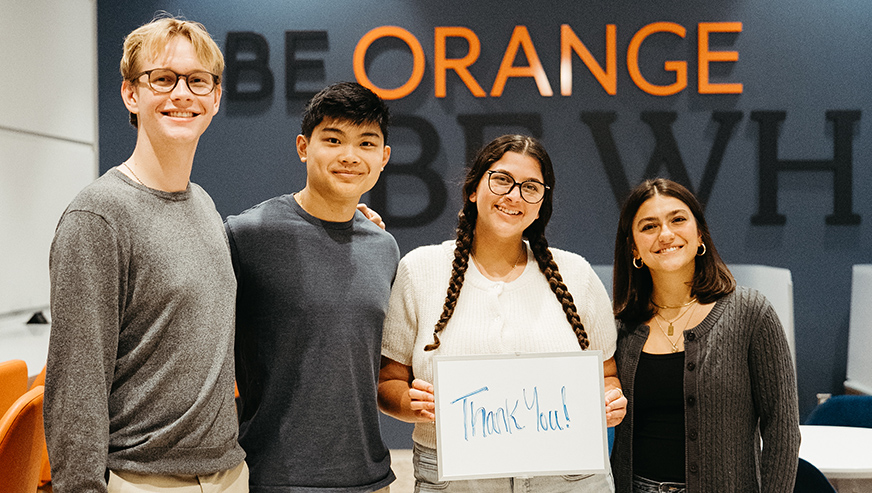
The integration of all three external departments under one leader is a new approach for Whitman to align efforts and create best-in-class external relations with its various publics that range from donors, alumni, peer institutions and the media. As part of the restructure, the marketing and communications department is continuing to increase its staff and resources. This includes a new executive-level role to champion the school’s marketing and brand strategy, brand reputation, positioning and storytelling to elevate the perception and awareness of the Whitman School among its many constituents.
2024-25 FUNDRAISING HIGHLIGHTS
$10.9 million total raised in cash donations (record year)
1,649 donors most participation since 2021
$3.2 million contributed to the Dean’s Fund (most successful year)
1,266 donors gave under $2,500—showing collective impact
Newly Created Whitman Leadership Circle Recognizes Outstanding Generosity
One of the biggest transformations to come out of the advancement office of late is the establishment of the Whitman Leadership Circle (WLC), which recognizes a newly formed giving society aimed at recognizing gifting commitments starting at $25,000 (over a five-year period) and rising through six levels that extend to $1 million or more from alumni, family, friends and other supporters.
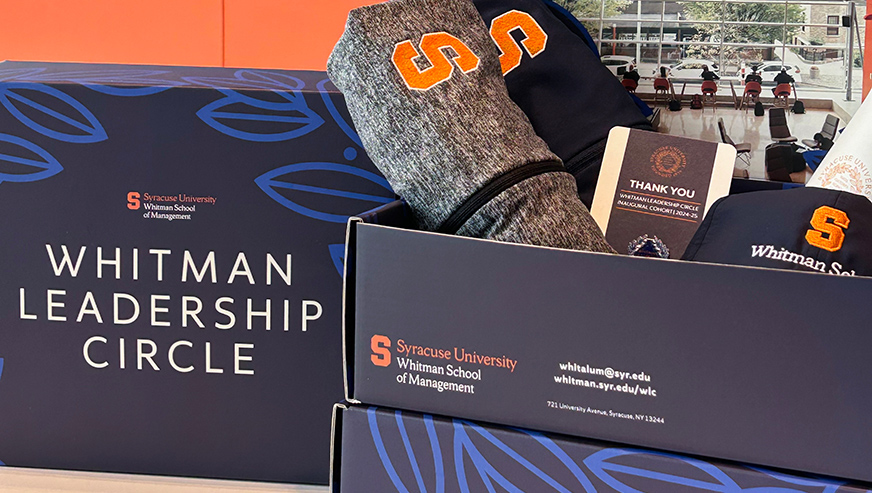
Direction for these gifts can be earmarked by the donor for any aspect of a Whitman education or be left to the discretion of Whitman leadership. In the first year, the WLC welcomed 49 members who made commitments that generated more than $6.3 million in new support.
According to Paulus, the WLC empowers donors to support Whitman through multi-year giving commitments that will help the school transform into a top 25 business school over the next five years.
Darren Mungkhalodom ’19 M.S. recently became a WLC member after making a $50,000 pledge to establish the Darren Mungkhalodom G’19 Retention Scholarship. An entrepreneur at heart since he was a 9-year-old kid selling chocolate bars and baseball cards to make extra money, today Mungkhalodom, a military veteran, is a restaurateur and also owns Fresh Coat of Painters with franchises in Rochester, New York; New York City and Florida.
“My parents weren’t rich, which is why I was always looking for opportunities to make some money as a kid—and throughout every step of my career since then,” he says. “I came to Whitman for a master’s degree to get some more formalized training in entrepreneurship, and after meeting Vice Chancellor Mike Haynie, also a veteran, and having such a great experience there, I knew I was going to find a way to give back and support the school.”
Since then, he has become more engaged with Whitman, including serving as a judge for last spring’s Capstone competition.
“It is truly amazing what these kids are doing and the skills they have,” Mungkhalodom says. “I was very impressed by the high level of competition and innovation coming from Whitman students during the Capstone competition, and I’m certain the Whitman School is on the right track to reach its goals.” Enthusiasm and support like Mungkhalodom’s are exactly why the WLC was formed to harness the power of the collective community to transform the Whitman School through philanthropy, according to Paulus.
WHITMAN LEADERSHIP CIRCLE GIVING LEVELS* | WHITMAN LEADERSHIP CIRCLE BY THE NUMBERS | |
$25,000 ($5,000/year) | $25,000+ entry-level commitment | |
$50,000 ($10,000/year) | 6 giving Levels up to $1 million+ | |
$100,000 ($20,000/year) | 95 members to date | |
$250,000 ($50,000/year) | $6.3 million in new support | |
$500,000 ($100,000/year) | ||
$1 million+ | ||
*over a five-year period |
“In just one year, we have seen alumni, parents and friends step up to answer this call in extraordinary ways,” says Paulus. “This momentum is reflective of the energy surrounding the Whitman School, and our team is excited to continue connecting the Whitman community to meaningful opportunities that ultimately support our students and get us closer to our Transformation 2030 goals.
Big Moves Enhance Facility and Physical Learning Environment
Over the summer of 2025, there were a lot of big moves, both within departments and within the Whitman building to better align workflow.
Some of these included:
- Combining our recruiting teams, both graduate and undergraduate, in Suite 111.
- Moving the alumni and external engagement team to Suite 114 for easier guest access.
- Placing student-facing IT staff in the computer lab on the second floor.
- Creating a one-stop academic advising shop, both graduate and undergraduate, in Suite 215.
- Building an operations and services office in Suite 311 to include nonstudent facing IT, marketing and communications, faculty support and budget/administration teams.
- Emphasizing a focus on experiential learning and student experience by placing them together in Suite 315.
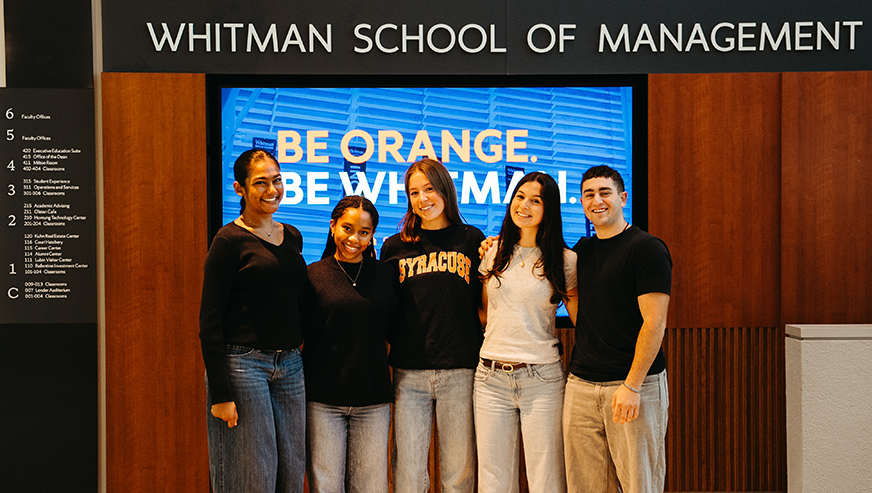
Students posing in front of new signage by Whitman’s main entrance
In addition, a number of significant building upgrades have been made on every floor, including new digital signage and wayfinding, suite improvements, a new modern building entranceway, a lounge outside Lender Auditorium and a heated rampway to combat ice and snow at the building entrance.
Additional plans include new faculty offices on the fifth and sixth floors, notable improvements to Olsten’s Cafe and final touches to much of the environmental signage and branding.
First Parent Advisory Council Expands Network and Support
Another initiative to help transform the school and enhance connections with another key audience is the Parents Advisory Council (PAC), established in 2024-25 to allow Whitman to tap into the network and insights of many parents working within key areas of the business world who are willing to enhance the student experience and placement after graduation. Interested parents serve two-year terms focusing on the three core areas: career readiness and job placement, student experience, and philanthropy and community building.
PAC member Derek D’Antilio, CPA, P’28, is proud that his son, Alex ’28, is a student at the Whitman School. “
Alex’s experience so far has been fantastic. He’s thriving, has made many friends, is participating in Greek life, sports and social clubs,” says the proud dad, who is the executive vice president, chief 2025-26 PARENTS ADVISORY COUNCIL f inancial officer and treasurer of Allegro with more than 20 years of financial and operating experience in semiconductor and high tech companies. “My son is majoring in accounting and already had a great internship this past summer. His experience at the Whitman School has been even better than I expected it to be.”
D’Antilio says he likes what he sees going on at the Whitman School, both right now and in its intention to rise in the rankings.
“I have a bit of an entrepreneurial bent myself, and, of course, when I met Mike Haynie, a fellow veteran, I really wanted to get involved and offer my expertise in any way that would be beneficial to the school. Plus, it’s a chance to come to campus more and spend some time with my son,” says D’Antilio, who is also a WLC member.
2025-26 Parents Advisory Council
- David A. Altman ’99, P’28
- Derek P. D’Antilio P’28
- Maya M. Eckstein L’95, P’28
- Jonathan E. Kass P’26, P’29
- Stacey Kochanowski P’25, P’27
- Vinny G. Lobdell Jr. P’28
- Kerstin Osterberg P’28
- Jason Rich P’26, P’27
- Michael Richman P’22, P’28
- Lin Rogers P’28
- Alisa Silverberg ’85, P’27
- Lisa Valastro P’27, P’29
As the 2025-26 academic year is already well underway, the efforts of Transformation 2030 are becoming apparent as the news spreads throughout the Whitman community and beyond. Like any success in the world of business, the goals and expectations are high, but the commitment and hard work are even higher, as the Whitman community works together to see the school reach the top 25.
“This is an exciting time in the history of the Whitman School. And, while 2030 seems like a long time from now, we know we have a lot to do in what is really a short, five-year window. We intend to be aggressive and move fast, as it is a must that we keep pace with the continuous changes to the business landscape,” says McKelvie. “It’s a challenge. It’s a risk. But, in 2030, there will be reward, as we are confident that we will be ranked among the top business schools in the nation. The anticipation of great things to come is already palpable within the Whitman School. And there’s nothing that makes my day more than walking down the halls of Whitman and having a student look at me and say, ‘top 25 in five.’”
Yes, You Can Help Transform the Whitman School
As Whitman pursues this bold but attainable goal of becoming a top 25 business school by 2030, we’re counting on your participation, too. Want to know how you can help?
- Hire a Whitman student for an internship or job opportunity.
- Host and mentor students eager for an inside look at career possibilities.
- Open your network connections to Whitman.
- Use your expertise to judge a business competition.
- Invest through philanthropy—from an annual gift.
Or, fill out our submission form, and we’ll help you find the best way for you to take part in Transformation 2030.