

Big Ideas Take Center Stage at Whitman’s Fall 2025 Capstone Pitch Competition
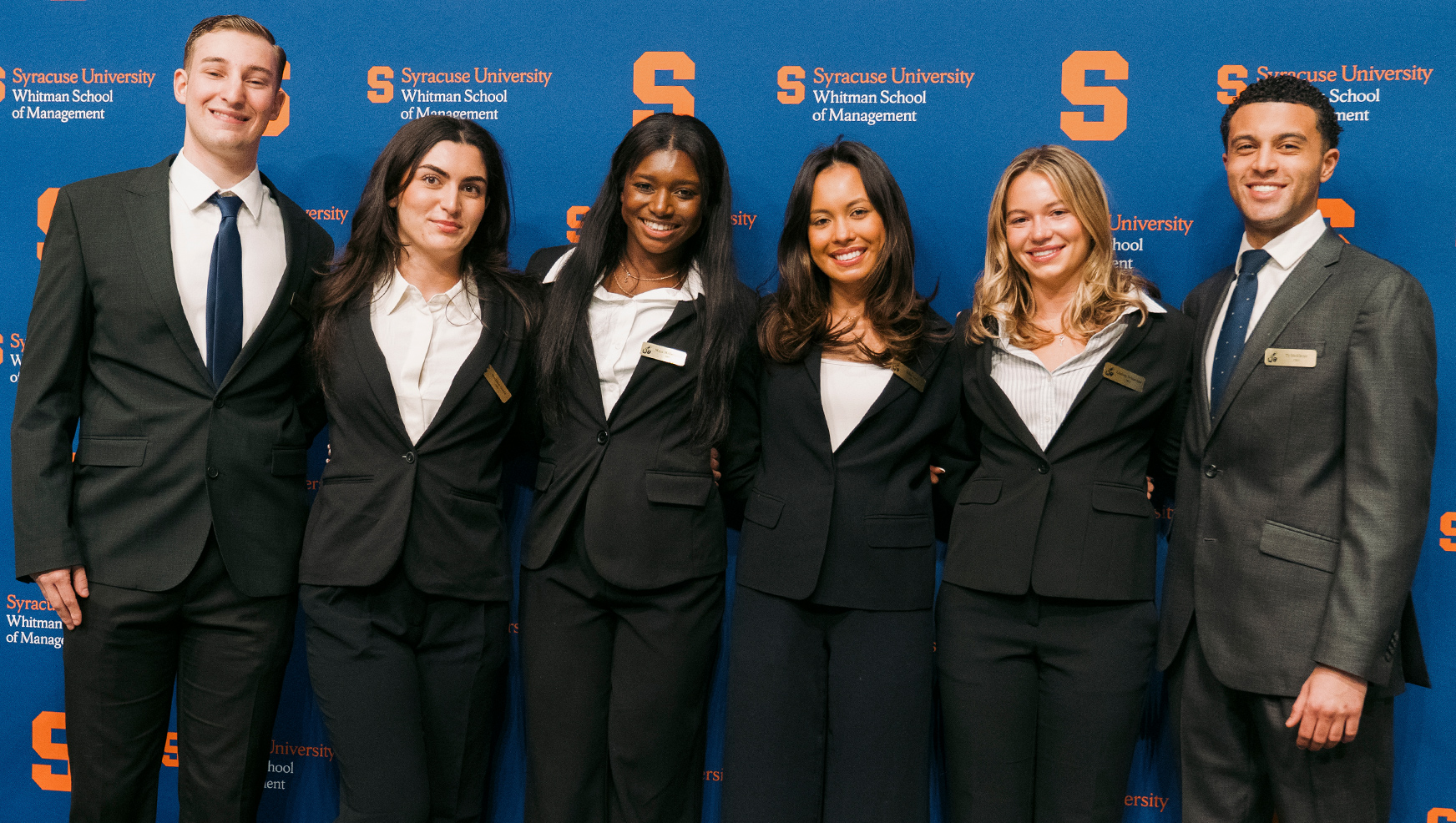
Winning team WordBuddy: (from left) Shane Stockfield, Madison Gould, Maya McDermott, Riley Love, Lindsay Schiavone and Ty McElroye.
Seventy-six teams packed into the National Veterans Resource Center for the fall 2025 Capstone Business Competition. The crowd created a rowdy atmosphere that filled the space from wall to wall. One by one, the 16 finalist teams were announced, each sending a representative forward to give a two-minute pitch in front of the judges and the entire field of competitors. When the judges announced their decision, WordBuddy, guided by Professor of Entrepreneurial Practice John Torrens G’93 (EDU) and created by Class of 2026 students Maya McDermott, Madison Gould, Ty McElroye (WSM/MAX), Lindsay Schiavone, Riley Love and Shane Stockfield, took first place.
Capstone is part of the Whitman School’s portfolio of experiential programs. It is the culminating experience for Whitman students, where teams apply what they have learned to create a new product, service or business model with real-world potential. Each concept must show how it creates economic value, outline a path to $3 million in revenue within five years and demonstrate the ability to attract more than $100,000 in outside investment. Students present their ventures to industry professionals in a competition for top honors.
Earlier in the day, all Capstone teams presented in rounds judged by alumni entrepreneurs, faculty members and business professionals. Teams presented in 16 rooms throughout Whitman, where judges scored each concept and selected a room winner. By late afternoon, everyone gathered to learn which teams would advance to the final round.
After the 16 representatives finished presenting their pitches to the panel of judges, everyone settled into a waiting game as the judges stepped aside to make their decision. The final round panel included Patrick A. Mannion ’80 MBA; Cary Mullin ’08 MBA; Brandon Glasgow ’13; Honora Spillane L’09, G’09 (MAX); and John Karedes ’90 MBA, who reviewed the finalists and prepared to select a winner. The judges combined their scores with the audience favorite score, scores from a panel of faculty who judged their full business plan, and scores from first-round judges that attended the pitch-off.
The first-place team, WordBuddy, impressed judges with a solution for neurodiverse learners designed to make reading more accessible. Built around the tagline “turning tricky words to tiny tricks,” the concept gives students simple tools to break down difficult vocabulary and improve retention. The team projected a Year 5 valuation between $1.6 million and $32 million and asked for $900,000 for 30% equity and a seat on its board of directors. The strength of the idea and its clear potential made WordBuddy one of the standout pitches of the night.
“This idea came from what I saw every day while working as an aide in special education classrooms,” says McElroye, who spent much of his early schooling alongside neurodiverse learners. “I watched students struggle with reading comprehension and vocabulary while teachers tried to meet every individual need at once. We built WordBuddy to fill that gap. To see it recognized like this after so many long nights makes us even more excited about the difference it could make for kids everywhere.”
Sonolite took second place with team members Rilee Flynn ’26, Zach Garby ’26, Lauren Hannafin ’26, Emmy Henning ’26 (WSM/NEW) and Tim Mak ’26, advised by Professor of Entrepreneurial Practice Ken Walsleben. Their product is an acrylic window insert designed to significantly reduce outside noise, offering an affordable and easy-to-install solution. The judges recognized the practicality and market potential of the product, placing it solidly in second.
BrewBlock finished in third place with team members Dhruv Goyal ’26, Roisin Walsh ’26, Jesse Lawrence ’26, Alexandra Rosenberg ’26 (WSM/NEW) and Deen Kasuba ’26, advised by Professor Torrens. Their venture repurposes beer spent grains into durable, sustainable bricks, offering breweries an environmentally friendly way to reuse waste while lowering material costs for builders.
Honorable mentions went to OptiVera and ScrubHub. OptiVera, created by Jaxon Calvert ’26, Caitlyn Kutzscher ’26, Julia Mara ’26, Ben Martin ’26 (WSM/NEW), Jackson Reid ’26 and Ryan Schwartz ’26 and led by Associate Professor of Entrepreneurship David Park, is an over-the-counter pre-exposure eye drop designed to protect the eyes before irritation during swimming or water sports. ScrubHub, developed by Samantha Black ’26, Erin Calkins ’26, Diamonte Giacovelli ’26 (WSM/NEW), Kayla Kavakeb ’26 (WSM/NEW) and Kfir Shoham ’26 and advised by Professor Walsleben, features a device that cleans household sponges more effectively and extends their lifespan.
“There is a unique energy that fills the building on Capstone day, which is my favorite day of the year, as our seniors bring forward the ventures they have shaped through curiosity, persistence and collaboration,” says Interim Dean Alex McKelvie. “The concepts showcased this semester reflect not only the hard work of the past 15 weeks, but the broader foundation of insight, discipline and creativity our students have built over their four years at the Whitman School. I am proud of every team that stepped up to present, and I extend my congratulations to the winners, the full slate of participants and the faculty who guided them throughout this remarkable journey.”
The fall 2025 Capstone Business Competition highlighted the ambition and problem-solving power of Whitman’s seniors. Each team brought a real-world idea shaped by months of work, classroom learning and collaboration.
Judges who helped with the first-round of the competition included Eric Alderman L’75; Barbara Ashkin ’74 (A&S), ’77 M.S.; Elvis Avdic ’11, G’18 (iSchool), ’25 Ph.D. (MAX); Ryan Benz ’11; Andrew Biss G’09 (ECS); Blake Brossman ’98 (VPA); Rickey Brown ’06; Brady Cass; Anna Chernobai, professor of finance; Holly Corbett G’21 (NEW); Lee DeAmicis; Mike Durkin; Jeff Eades ’85 (A&S); Josh Epstein ’00; Adam Gold ’06 (NEW); Patrick Griffin ’20 M.B.A.; Janice Harvey ’73 (HD), ’85 M.S.; Tyler Impey ’19 MBA (WSM/ECS); Michael Jennings ’16 (A&S); Tiffany Jones ’17 (A&S), ’19 (Falk); Peter King ’08; Ron Klein; Jennifer McGee, WISE Center program coordinator; Maojiao Mei, Ph.D. student; Cameron Miller, associate professor of management; Helen Mucciolo ’88; Nicole Osborne ’14 (A&S), G’20 (iSchool); TJ Perkins ’15; Penelope Pooler Eisenbies, professor of finance practice; Brigid Purtell; Ian Rennie L’09, assistant teaching professor of management; Jeff Rogers; Cassandra Rosique; Mark Russell; Frank Shultz ’03 (A&S/NEW); Tamara Seredneva ’19 MBA; Siko Sikochi, associate professor of accounting; David Skoler ’15 (WSM/iSchool); Zachary Sussman ’22; Mark Travis; Jim Tylenda ’72 MBA; Fred Vona ’11 MBA, professor of practice; Michael Woloszyn ’10 MBA; and Joyce Zadzilka, professor of accounting practice. Business plan reviewers included Arielle Newman, assistant professor of entrepreneurship; Hyoju Jeong, assistant professor of entrepreneurship; and Marie Adornato, adjunct professor.