Five Takeaways: Ron O'Hanley on Leading Through Uncertainty in a Changing World
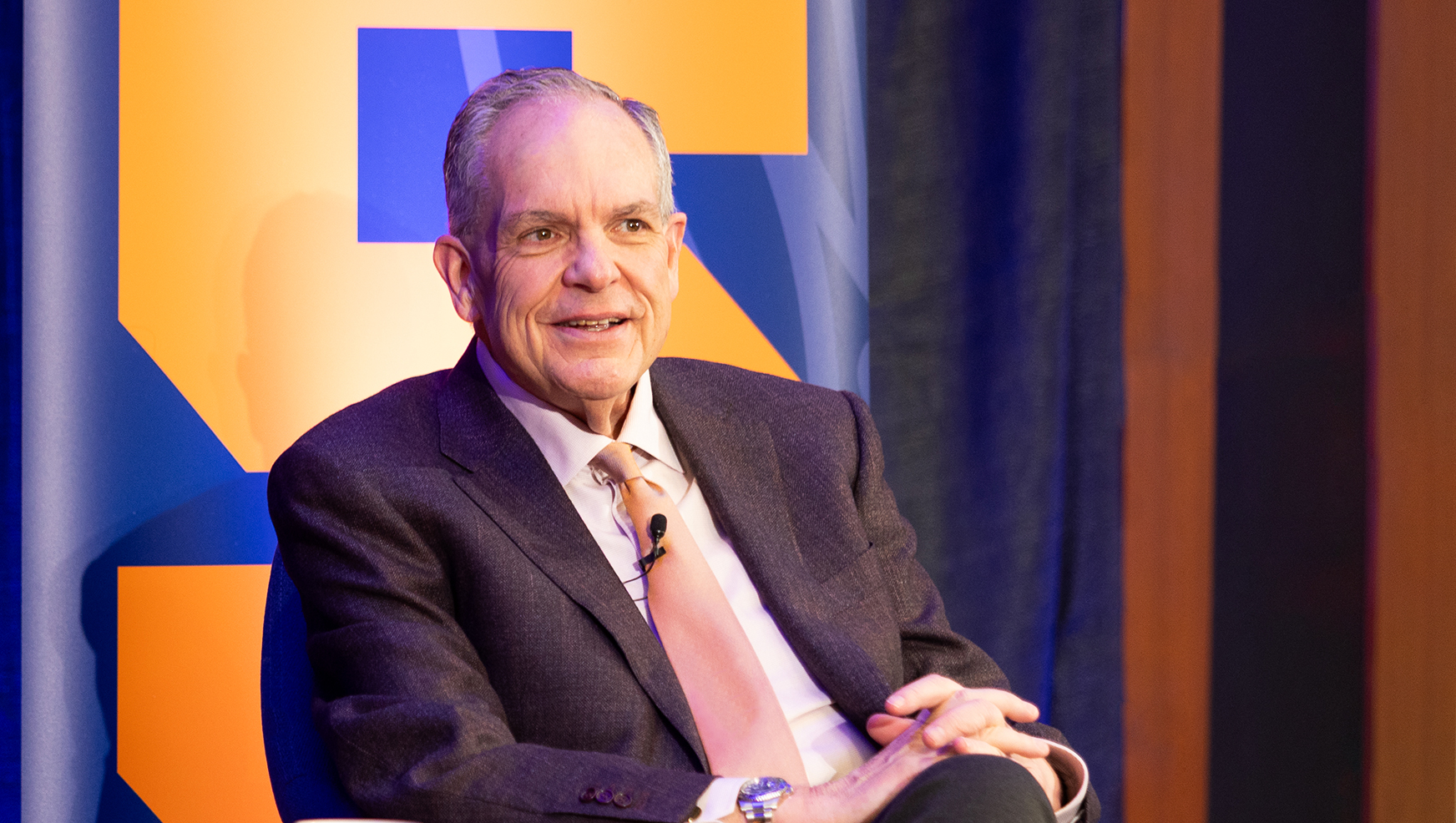
Ron O'Hanley did not arrive at Syracuse University with a master plan. He thought he might become a lawyer or a diplomat. What he found instead was a winding career path through consulting, asset management, and eventually, the CEO's chair at one of the world's most systemically important financial institutions. O’Hanley is Chairman and Chief Executive Officer of State Street, a 232-year-old firm that serves over 100 markets, provides investment management for $5.7 trillion in assets and provides custody or servicing for more than 11 percent of the world's financial assets. He has spent decades navigating financial crises, technological transformation, and the increasingly complex intersection of business and geopolitics.
A proud Maxwell School alumnus who earned his Bachelor of Arts in Political Science at Syracuse University before going on to earn his MBA from Harvard Business School, O'Hanley returned to campus for a fireside chat with Whitman Interim Dean Alex McKelvie as part of the school's IMPACT Executive Leadership Speaker Series. Speaking to a student-filled Lender Auditorium, he drew on more than three decades of experience across McKinsey, Mellon, Fidelity, and State Street to share candid insight on building a career, leading large organizations, and preparing for a future defined by uncertainty.
Here are five takeaways from the conversation.
Not knowing what you want is not a disadvantage. It's a starting point.
When I was young, I honestly didn't know what I wanted to do. I came to Syracuse thinking I wanted to be a lawyer or a diplomat. When you're undecided, you go on to further schooling. I went to business school, still wasn't sure, and learned about this thing called consulting. I said, this is awesome - I don't have to make a decision on what I want to do. I can just be a consultant and take a series of postgraduate courses.
McKinsey turned out to be a tremendous place for me. I never thought I'd be there as long as I was, and I had no intention of leaving. What often happens is a client comes to you and says, okay, you think you're so smart, you told us what we should do. Would you come and actually do it? At first, I said no. Then I realized they were offering me an extraordinary opportunity; one I wouldn't have given myself. I hadn't really managed anything, and here they were asking me to come run and grow their institutional business. That life lesson - recognizing the perfect opportunity even when it comes unexpectedly - has stayed with me.
In a crisis, the people around you will define the moment.
During the 2008 financial crisis, the money market funds I oversaw were at risk of breaking the buck - meaning clients who had put in $100 might not get $100 back. We ran out of options to protect the fund values, and I had to prepare to shut down the business the following morning. This was a very large business. It employed close to a thousand people. Many of them knew that there would be no jobs after this.
What I will never forget is that every single one of those people, knowing they were going to lose their jobs, stayed completely focused on making sure they did right by every underlying client. I was overwhelmed by their commitment. Fortunately, that was the day the government announced the TARP program, which restored confidence in the markets overnight and saved the funds. But those people hold a permanent place in both my head and my heart. That's what I mean when I say the hardest decisions you make are about people, not numbers.
Complexity is often the real cost problem, not spending.
When I became CEO of State Street, I inherited a significant cost challenge. It would have been easy to conclude we were just being profligate. But when we diagnosed the problem, it had nothing to do with overpaying people or having too many of them. It was about how we had grown: rapidly, globally, through a lot of M&A, with not enough emphasis on integration. And we had built a reputation on servicing the largest, most complex clients in the world, which is fine when you're getting scale, but we weren't getting scale.
The answer was not to tighten belts. That would have driven service quality down and put us into a downward spiral of losing clients. The answer was simplification. That became the watchword; in the office we had one big black-and-white poster that just said "simplify." In any transformation, being able to organize people around a single governing idea is enormously powerful. The problem isn't always what it looks like from the outside.
AI isn't eliminating jobs. It's changing what jobs look like.
I'm not among those who believe we're heading toward wholesale net job destruction. What you actually see is not jobs being eliminated, but tasks and components of jobs being changed. That's been happening for a long time. In our firm, fund accountants used to be entry-level roles: we measured how many we needed per fund. Technology improved, the ratio flipped, and today a fund accountant is a highly skilled senior role, not an entry-level one. The job didn't disappear. It evolved.
What's also true is that AI creates new demands. Where we used to need large teams doing deterministic reconciliation work, we now need people making judgment calls that machines can't make. The challenge isn't job loss; it's building organizations agile enough to continuously reshape themselves. We've started treating our AI agents as employees. They have employee numbers, they get permissioned like staff, and they're managed rather than set and forgotten. That shift in mindset changes everything about how you deploy this technology responsibly.
The most important skill you can build is problem-solving, paired with a broad education.
I get asked all the time: what should current students be studying? What should my kids focus on? My answer is always the same: we need extraordinary problem-solvers and strong communicators. I cannot predict what the world will look like in five years. I certainly couldn't have predicted the geopolitical situation or the technology landscape we're navigating now. But there is always room for someone who can look at a problem, perhaps not know the answer but know how to find it.
What I wish I had done differently here at Syracuse was take a broader set of courses. I was at Maxwell, and I got to business school needing something close to remedial accounting. Use your electives. Take something outside your comfort zone - at Newhouse, at Whitman, anywhere on this campus. You'll be a more interesting person. You'll learn things you wouldn't otherwise learn. And you'll be a better problem-solver for it. That, combined with the fact that you are AI natives in a way that none of us who came before you are, is a genuine competitive advantage. Bring both of those things together, and you will stand apart.
---
O'Hanley closed the conversation by encouraging students to think about the inextricable link between business, government, and policy — a theme that has defined much of his own career. "I think understanding that is actually quite important," he said, "and I think historic context helps a lot." For those looking to build careers in global finance or enterprise leadership, his message was clear: stay curious, stay broad, and be ready for a world that will not stop changing.