

Investing in Whitman Students: New Angel Network Puts Students in the Center of the Founder/Investor Ecosystem
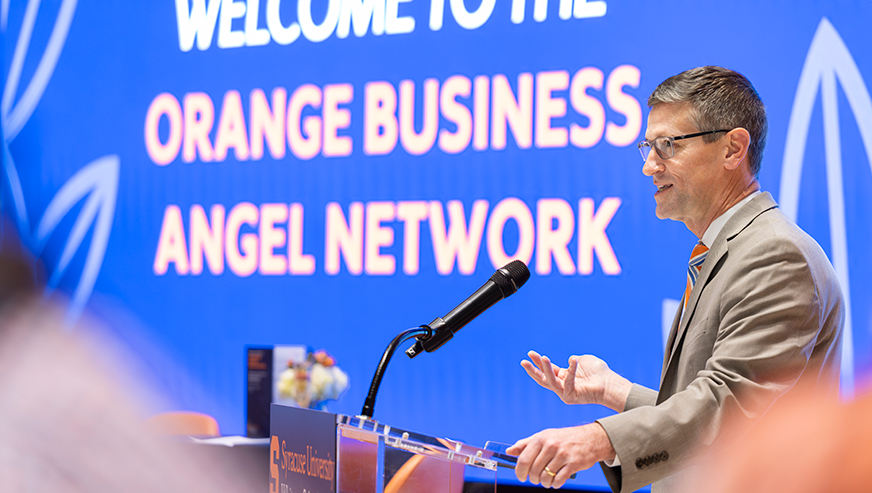
During one of the first meetings of the inaugural Orange Business Angel Network (OBAN) course, Associate Professor of Entrepreneurship Jeff Gish brought three jars into class: One was transparent and filled with chocolates; one was opaque and held the same types of chocolates. The third jar was not only opaque but also contained different types of objects.
“That third jar was intended to represent what angel investing looks like, because you never really know what’s going to happen,” says student Will Lewandowski ’27. “You might pull something great out of the jar. You might pull out something that you didn’t expect was going to be in the jar… When you’re in the process of angel investing, it’s nonlinear.”
Officially launched in January 2026, OBAN seeks to fill the information gap. While many angel networks connect entrepreneurs with investors, OBAN is centered around a crucial third component: A select cohort of students in the Whitman School of Management is helping to make the process more transparent. Under the direction of serial entrepreneur and investor Gish, students will research the founders’ businesses and create due diligence reports for the entrepreneurs to use in making independent investment decisions.
Student-centered experiential learning
As part of the Transformation 2030 initiative, OBAN joins programs including the Orange Value Fund student-run hedge fund as a centerpiece of the Whitman School’s ever-expanding experiential learning offerings. As such, students are at the heart of OBAN. “Many university-affiliated angel networks operate outside of their institutions, with limited student engagement,” says Erin Draper, director of the Whitman School’s Experiential Center. “OBAN is different. Since it is built into the coursework, students are heavily engaged in the entire process – from due diligence to communications with angels and planning pitch days.”
Fifteen students, both graduate and undergraduate, are enrolled in the inaugural OBAN class. The average GPA of the cohort is over 3.7. “Every single person in the class is the type of student that goes out of their way to do new things, to build things and actually make an impact,” remarks Lewandowski, who previously founded two businesses and interned for a venture capital fund.
The program kicked off with a launch party on January 15, 2026, drawing entrepreneurs and investors from across the country. The event featured a panel including Zack Pecenak, who directs the Innovation Venture Capital Fund for Empire State Development and Jeff Knauss, CEO and co-founder of Arcovo AI, along with Syracuse University Advisor for Strategic Initiatives Linda Dickerson-Hartsock.
Also in January, students began the classroom portion of the three-credit OBAN course. “We cover the full spectrum of angel investing principles,” says Gish. “We explore how to find and evaluate deals holistically, looking at the product or service offering, market size and fit, the management team and the business model. For promising companies, we dive deep into due diligence, financial statements, term sheets, valuation methods, securities law, corporate structure and tax considerations. Students learn about negotiation, investor involvement post-investment and exit strategies.”
The semester culminated in a pitch day in April. Students organized the event, facilitated pre-pitch meetings between entrepreneurs and investors and presented the analysis from their due diligence.
Gish, who most recently taught management and entrepreneurship at the University of Central Florida, fits into a fairly niche Venn diagram. An entrepreneur and investor in early-stage ventures with a Ph.D. in management, he has both the scholarly chops to teach the theories of entrepreneurship and the hands-on experience in the investing world.
"Jeff is an exceptional scholar and award-winning teacher. In addition to his academic credentials, Jeff brings an abundance of entrepreneurial experience, having successfully sold businesses and been an angel investor. This combination is rare. His insights and background will help to elevate the student experience and help to guide OBAN from an academic and practical experience. He’s the right unicorn faculty member to see OBAN thrive," says Whitman School Interim Dean Alex McKelvie.
Gish’s teaching techniques, like the three-jar illustration, have made an impression on Lewandowski. “Professor Gish has been amazing in terms of some of the activities that he has done to get all of us to think about investing in different ways. These are activities that I’ve never seen before or heard of before, and they paint a really good picture in terms of how all of this works,” he says.
Building on the Orange network
As the name implies, every OBAN entrepreneur and angel must have some connection with the university. Whether they’re parents, alumni, students, or others in the community, they have a vested interest in the success of the entire network.
“These are people connected to our Orange ecosystem, which often means better access, warmer relationships and shared values,” says Gish. “Beyond the investment opportunities, investors contribute to something meaningful.”
Draper hopes OBAN will become known as a resource for Orange founders, facilitating not only capital infusion but also mentorship and guidance. “For a lot of early-stage founders, the right introduction or the right advice at the right moment matters as much as the capital,” she says.
For investors, OBAN students provide in-depth analysis that the angels themselves might not have the time to conduct.
“Our angels are busy, successful professionals,” says Gish. “They don’t always have the time to conduct exhaustive market research, dig through competitive landscapes, or build detailed financial models for every opportunity that comes across their desk. Our students provide that analytical horsepower. They’re hungry to learn, they’re not jaded by pattern recognition bias that sometimes affects experienced investors and they ask questions that might not occur to someone who’s seen a thousand pitches.”
An early advantage
According to Draper, more than half of the inaugural OBAN student cohort indicated in their applications that they are interested in starting a business after graduation. She hopes OBAN will help students gain the necessary experience to break into the insular field of venture capital. “It tends to be a field that's hard to break into without experience, so we’re giving students that foundation early,” Draper says.
Lewandowski, currently a junior majoring in entrepreneurship and emerging enterprises, wants to work in the entrepreneurial ecosystem, whether that’s as a founder, an investor, or some combination over the course of his career. He is excited to broaden his network with both investors and founders, noting, “I think it’ll be great to serve all of us down the road and continue to build a network of people who graduated from Whitman and from Syracuse and are doing things that are outside of the box.”
Or outside the jar, as the case may be.