


The Practice of Business: Whitman’s New Experiential Center Unites Hands-On Learning to Reinforce Business Education Outside the Classroom
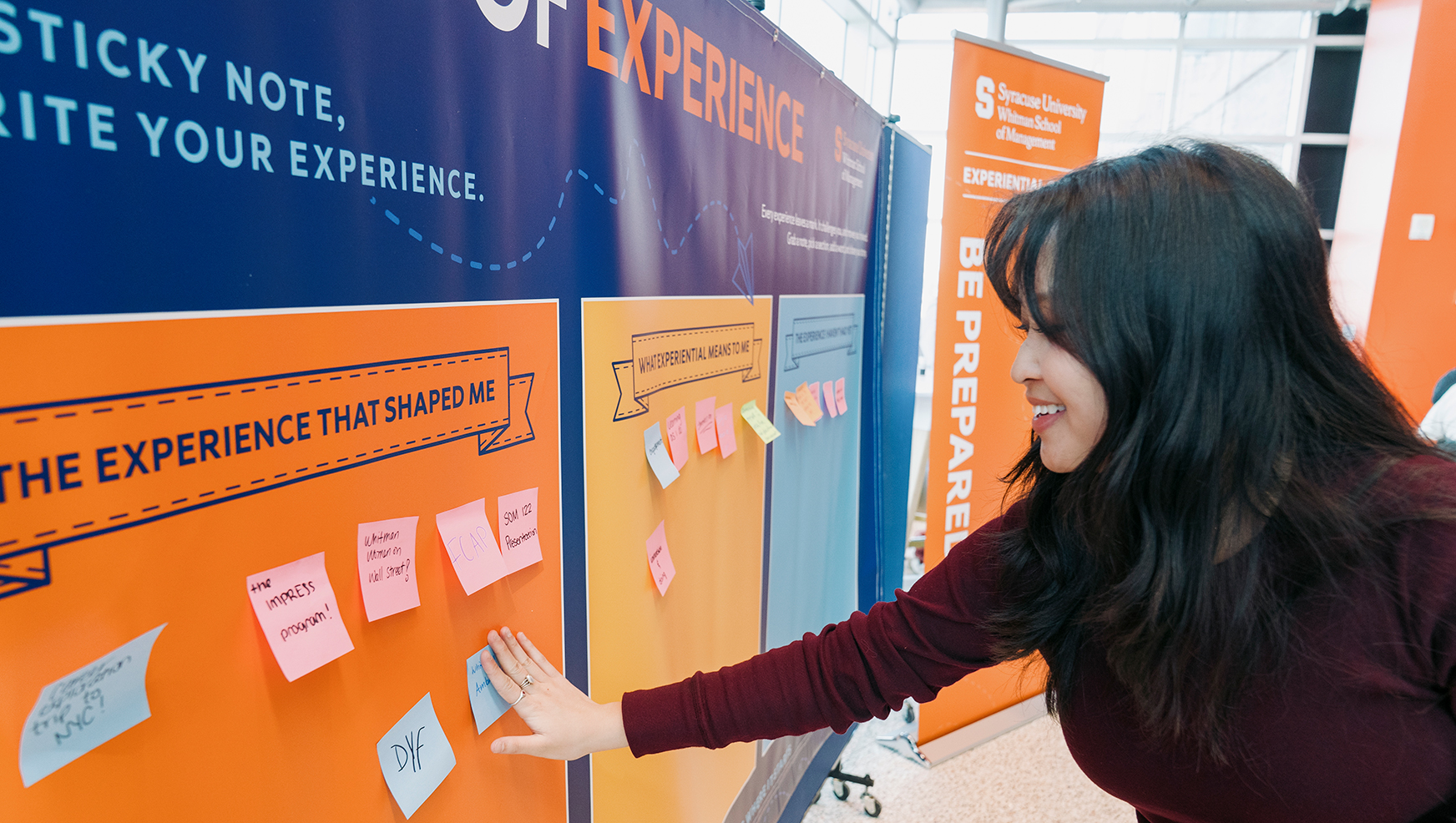
When the Whitman School of Management officially launched its new Experiential Center in March, the event looked a lot like the center itself: students practicing high-stakes conversations through VR headsets, navigating a Lego communication challenge under a time limit, pinning dream study abroad destinations to a world map and testing their business etiquette knowledge side by side with faculty and staff.
That was entirely by design.
“We wanted our launch to be experiential—to be very much the way our center operates,” says Erin Draper, director of Whitman’s Experiential Center. “It’s not just to build a resume. It’s to build proof that they’re ready.”
The Experiential Center is a unifying structure that brings together the many hands-on learning opportunities already in place across Whitman, making them more visible, coordinated and intentional. Its launch is a direct expression of Transformation 2030, Whitman’s roadmap to becoming a top 25 undergraduate business program, and of a conviction that has long shaped the school’s identity: that business education must extend well beyond the classroom.
“What we’re launching here is not just an office or a program,” says Whitman Interim Dean Alex McKelvie. “It's a defining commitment about who we are as a school and how we prepare our students. They pitch real investors. They solve problems for real companies. They travel the world. That really is what our new Experiential Center is all about.”
A Connected Experience
The center got its start last summer with new office space on the third floor of the Whitman School, and its scope is school-wide. Functioning as a hub, it houses programs such as global immersions, case competitions, and the Goodman IMPRESS professional development program while also connecting students to experiential opportunities across entrepreneurship, career development and beyond. The goal is to create a cohesive pathway so students can see how their experiences build on each other and apply their skills in industry. This fall, the center will launch an improved experiential transcript, a tool to help students track and articulate what they’ve done and translate it into career readiness.
The center is organized around four pillars: Be Global, Be Innovative, Be Collaborative and Be Prepared. Together, they define what a Whitman graduate looks like in practice—someone who has not merely studied business concepts but has applied them in realistic, consequential settings.
For many students, the launch event was the first time they had seen that full picture. Programs that once felt separate—study away trips, case competitions, industry certifications and leadership workshops—came together as part of a larger, intentional narrative.
“We want students to recognize that every experience they’re having at Whitman, inside and outside the classroom, is preparing them to lead in a real and complex world,” says Jenny Henderson, associate director of Whitman’s Experiential Center. “The center makes that connection visible and ensures every student knows how to access it.”
For Neeraj Mehta G’96, P'28, who has supported experiential learning at Whitman for the past five years, the growth of the center reflects a meaningful shift in what a business education can offer. “I have watched the program evolve from internships and study abroad into something far more expansive: case competitions, global immersion trips, company-sponsored projects, angel investing and more,” he says. “Every one of these experiences prepares students for day one on the job. That means a higher return on investment for every employer who hires a Whitman graduate.”
The center helps ensure experiential learning is accessible to all students regardless of budget, schedule, or location, with options ranging from on-campus simulations and case competitions to short-term global immersions and online professional development.
The Lightbulb Moment
At the Innovation station during the launch, a student received unexpected feedback from a VR interview simulation: when she paused to think, she looked off to the side, a habit that could read as disengaged to an interviewer.
“She didn't realize it," said Lynne Vincent, chair of the Department of Management, who observed the moment. The student reset and tried again, more deliberate this time.
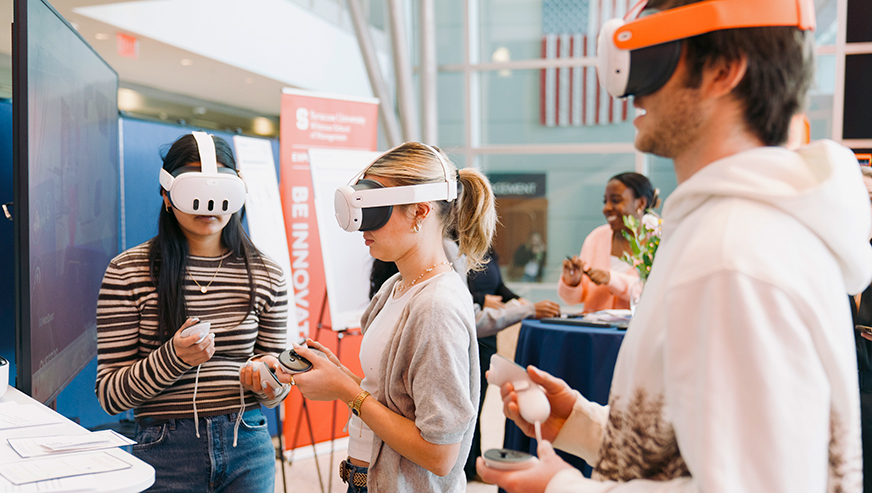
Students visiting the innovation station during the launch of the Experiential Center.
Across the room at the Be Prepared table, senior Jonah Heinrich guided peers through a display of skill cards ranging from elevator pitches to data analysis. Nearby, his fellow volunteer John Mozonski ’26 paused and looked at the display more carefully. “The more I read these cards, the more I realize I need to practice them myself,” said Mozonski, a senior majoring in finance and real estate.
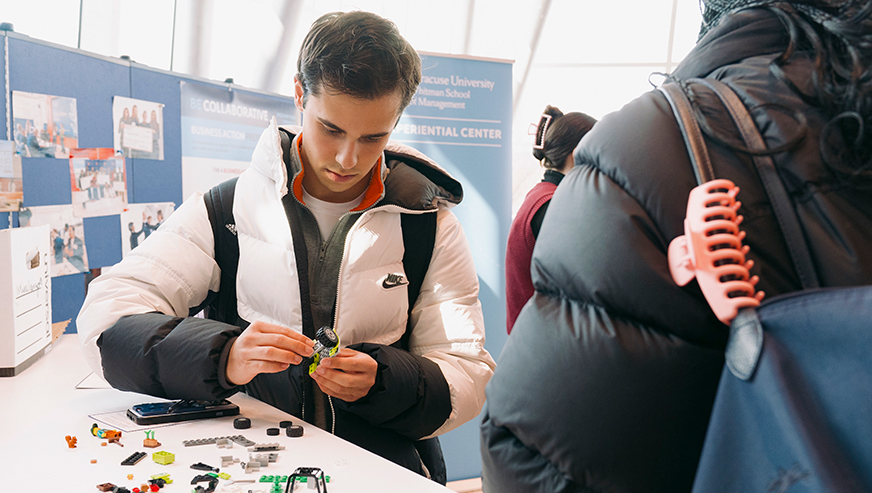
Student visiting the Be Collaborative station, trying the Lego challenge.
At the Be Collaborative station, MBA student Allison Hellman ’26 MBA, G’26 (A&S) facilitated a Lego challenge—one partner seeing the finished model and guiding the other to build it from verbal instructions alone—while sharing her own experience winning Whitman’s Graduate Case Competition. After the exercise, senior Odette Shirk ’26 (WSM/MAX) reflected on the gap between what she said and what her partner built.
“What Alyssa did totally makes sense based on what I said, but it wasn’t the outcome I hoped for,” said Shirk, a supply chain major. “It's a good reminder to consider communication in a lot of different ways to be clear and effective.”
For Shirk and her partner, Alyssa Tran ’27 (WSM/iSchool), a junior who had attended the Whitman London program, the event reframed experiences they had already had. “It’s basically how you learn outside of the classroom,” Tran said.
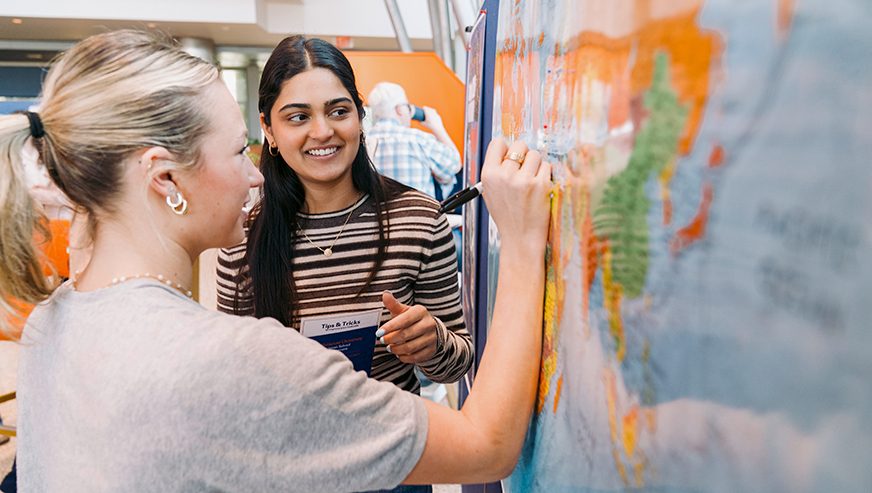
Students visiting the global station during the launch of the Experiential Center.
Those moments of recognition—when a student sees a gap, names a skill or connects an experience to something larger—are what Draper calls “lightbulb moments.” They are also what the Experiential Center is built to produce, not by chance but by design, and not just at a launch event but across every semester of a student’s time at Whitman.
“It’s about saying yes to experiences that lead to those lightbulb moments,” Draper says. “And making sure every student has the opportunity to have them."