

I'll Prove You Wrong! The Underdog Effect as an Antecedent to Entrepreneurial Action and Venture Persistence
Authors:
April J. Spivack, Hanken School of Economics (Finland)
Nick Smith, Northern Illinois University
Jeff Pollack, North Carolina State University
Jon Carr, North Carolina State University
Alex McKelvie, Whitman School of Management, Syracuse University
Journal:
Journal of Business Venturing (forthcoming)
Summary:
This study explores a surprisingly powerful motivator for entrepreneurs: being told you're going to fail. We find that when entrepreneurs receive negative feedback or doubt from others—investors, family, friends, mentors—many don't give up. Instead, they dig in deeper. Our research gives this phenomenon a name and a mechanism: the underdog effect. Across three separate studies involving over 1,400 entrepreneurs, we show that this effect is real, measurable and meaningfully linked to whether entrepreneurs keep going with their ventures.
Research Questions:
Why do entrepreneurs keep going even when others tell them they'll fail? Specifically, we examine how the psychological sting of being doubted translates into sustained action and whether who delivers the discouraging message matters.
What We Know:
Persistence is widely considered one of the defining traits of successful entrepreneurs. Prior research identified several drivers, most of them positive: passion for the work, confidence in one's abilities, a strong entrepreneurial identity and supportive social networks. But the psychological mechanics of how doubt becomes fuel are largely unexplored.
Novel Findings:
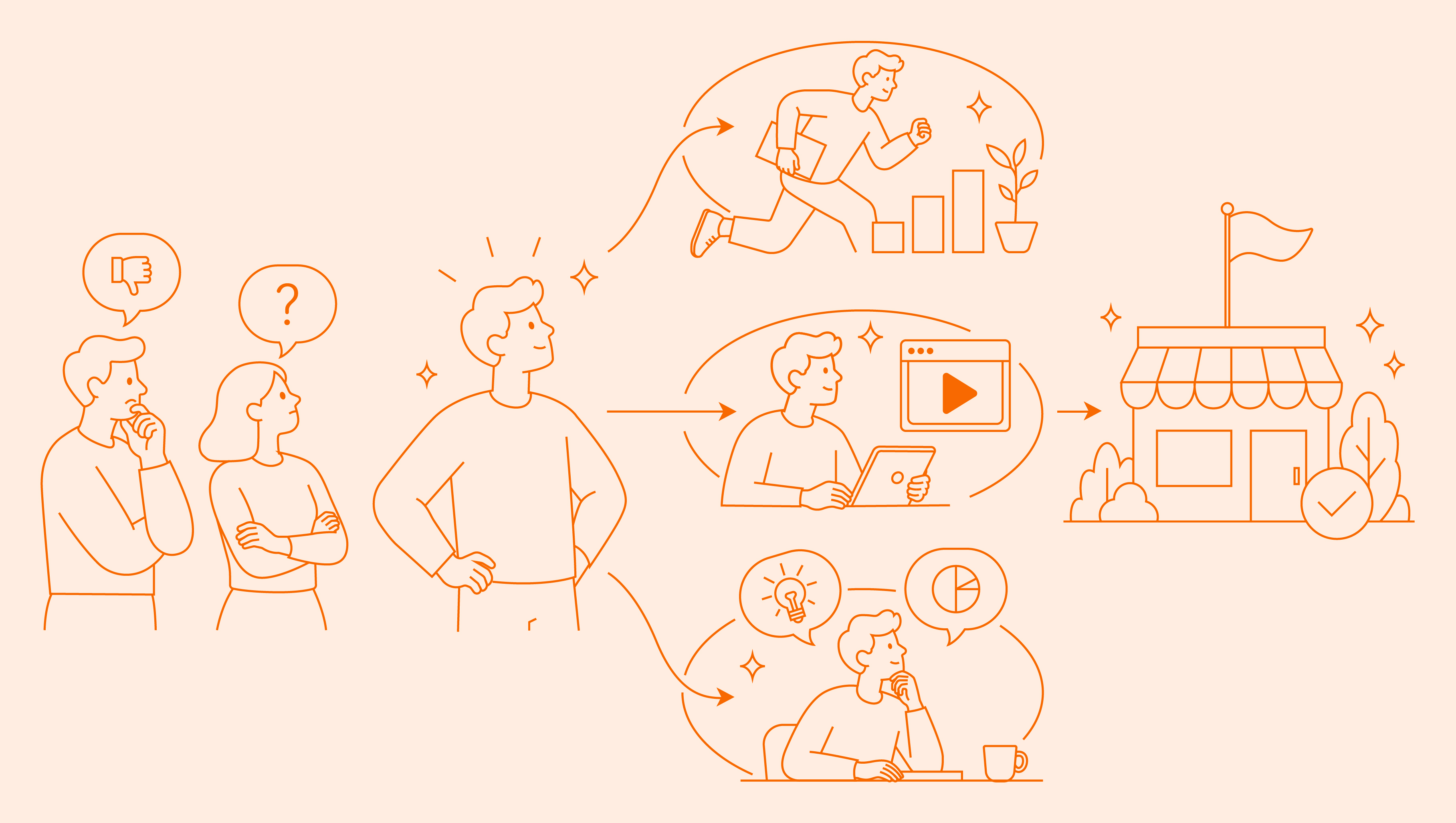
The most striking finding is that being told you'll fail can make you more likely to persist and reflects the drive to prove people wrong (the underdog effect). The actions behind this reaction—"boomerang effect"—show how entrepreneurs push back when someone tries to limit what they believe you're free to do. We find that those being told they would fail reported higher likelihood of persisting than those who received positive feedback or no feedback at all. This impact is stronger when that naysayer is seen as less credible or doesn’t know the industry. Persistence can be seen through specific actions (hustling harder, taking immediate steps, consuming entrepreneurship media, thinking obsessively about the venture), and across a three-month time horizon. This shows that the underdog effect is a relatively durable motivational force, not just a momentary emotional spike.
Novel Methodology:
We used a multi-study design that progressively builds confidence. Studies 1 and 2 used quasi-experiments where some entrepreneurs were asked to recall a time they were told they'd fail, while others weren't, isolating the psychological effect of receiving doubt. Study 3 used a time-lagged design, collecting data from the same entrepreneurs across three monthly intervals. This is stronger evidence that the underdog effect actually causes later persistence. We also conducted 15 in-depth interviews with real entrepreneurs, grounding the patterns in lived experience.
Implications for Practice:
For entrepreneurs: Doubt can fuel you, but the need to prove others wrong can also become a trap. If you're persisting primarily to spite a naysayer rather than because your venture genuinely makes sense, you risk escalating commitment to a failing idea.
Implications for Society:
This research reveals that adversity is not simply an obstacle to achievement. It can be a driver of it under the right conditions. Societies and institutions that write off certain people as unlikely to succeed may not just be wrong in their predictions — they may be actively fueling those people's determination to prove them wrong. There are potential downsides though: the underdog effect can feed obsessive thinking, unhealthy work habits, poor work-life balance and potentially poor decision-making about business viability.
Implications for Research:
This study is one of the first to show systematically that negative experiences can be just as powerful a fuel as positive ones. That's a meaningful shift in how we think about entrepreneurial motivation. Mapping out how it works (from receiving doubt to feeling reactance to wanting to prove people wrong to taking action) opens up a new set of questions worth exploring, including individual differences, timing and repetition of feedback, and when persistence becomes problematic.
Full Citation:
Michaelis, T.L., Spivack, A.J., Smith, N.A., Pollack, J.M., Carr, J.C., & McKelvie, A. (2026). “I'll prove you wrong! The underdog effect as an antecedent to entrepreneurial action and venture persistence”. Journal of Business Venturing, 41(3), forthcoming.