

2026 Whitman Dean’s Sustainability Challenge Showcase Highlights Student Innovation Inspired by U.N. Sustainable Development Goals
Converting semiconductor manufacturing waste into greener, stronger concrete. Designing an affordable electronic Braille reader for blind children in India. Building a peer-to-peer clothing rental platform to reduce fast fashion on campus. These were just some of the innovations presented at the third annual Whitman Dean’s Sustainability Challenge Showcase on April 16 in Flaum Grand Hall at the Whitman School of Management.
The Dean’s Challenge is a semester-long initiative that encourages interdisciplinary collaboration as students apply their critical thinking and problem-solving skills to develop innovations inspired by the 17 United Nations Sustainable Development Goals (SDGs), established to “promote prosperity while protecting the planet.” Students participated out of genuine interest in sustainability and innovation, embracing the experience as a meaningful opportunity to make an impact. The challenge is part of Whitman’s growing portfolio of experiential learning programs, rated #1 in the nation for student participation by Poets&Quants in 2026. It is also a direct expression of Transformation 2030, the school’s strategic plan to become a top 25 undergraduate business program. Student teams competed for a share of $25,000 in prize money.
"The Dean’s Sustainability Challenge continues to grow in both scale and ambition,” said Erin Draper, director of the Whitman School’s Experiential Center, who organized the initiative. “What excites me most is seeing students from across the University come together around problems that genuinely matter and bringing real rigor and creativity to solving them. We’re grateful to the many alumni, faculty, staff and friends of Whitman who supported our students throughout this process.”
Ten teams submitted written reports earlier in the semester. Each team was required to include at least two Whitman students. Prior to showcase day, a panel of alumni reviewers—Chandini D. Purnesh ’09 MBA, founder and CEO of LunyBee and Golden Wood; Priyal Chheda G’22 (A&S), technical program manager at Amazon Web Services; Alexandria Lee ’15, strategy senior manager at Accenture; Haerim Hong ’13, senior manager of sustainable brands and products at Target; Steven Fortino ’14, lead project manager at National Grid; Harris Feldman ’12, principal of carbon programs at Amazon Web Services; and Annie Archibald ’17, senior business development manager at Amazon—scored the written reports to determine the five finalist teams. On the day of the event, all ten teams displayed their work during a poster session reviewed by Sara Martin, principal at Critical Path Engineering Solutions; Charles Duprey ’05 (WSM/MAX), founding president of Naturecycle; and Anywhere Sikochi, associate professor of accounting at the Whitman School. Audience members cast votes for their favorites as well.
The competition intensified as finalist teams delivered six-minute pitches followed by three minutes of Q&A. This year’s judges were Carolyn Cole ’87, manager of energy initiatives at the United States Postal Service; Andy Ertel, CEO of Restoration Climate; James Jordan ’75 (A&S), ’77 MBA, president of James Jordan Associates Architects; Cindy Andela, CEO of Andela Products; and Jerome Ryan ’99, ’13 MBA, head of operations at Carbonaires.
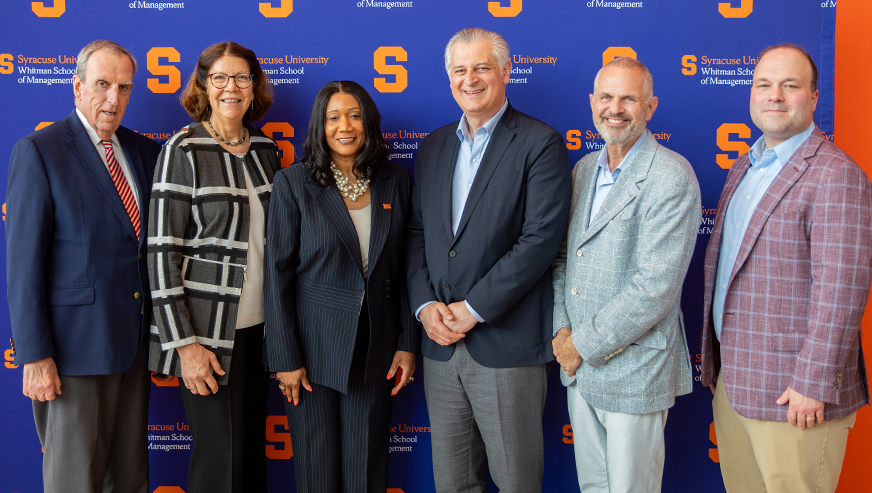
James Jordan, Cindy Andela, Carolyn Cole, Jerome Ryan, Andy Ertel and Charles Duprey
“The breadth of ideas on display at this year’s Showcase is a testament to what students can accomplish when they are challenged to think boldly about the world's most pressing problems,” said Whitman Interim Dean Alex McKelvie. “This is experiential learning at its best: students doing real work, tackling real challenges and producing real results. At Whitman, that is not a supplement to the curriculum. It is the curriculum. I am incredibly proud of every team that participated this year, and grateful to the alumni, faculty and partners who made it possible.”
The following awards were presented at the event:
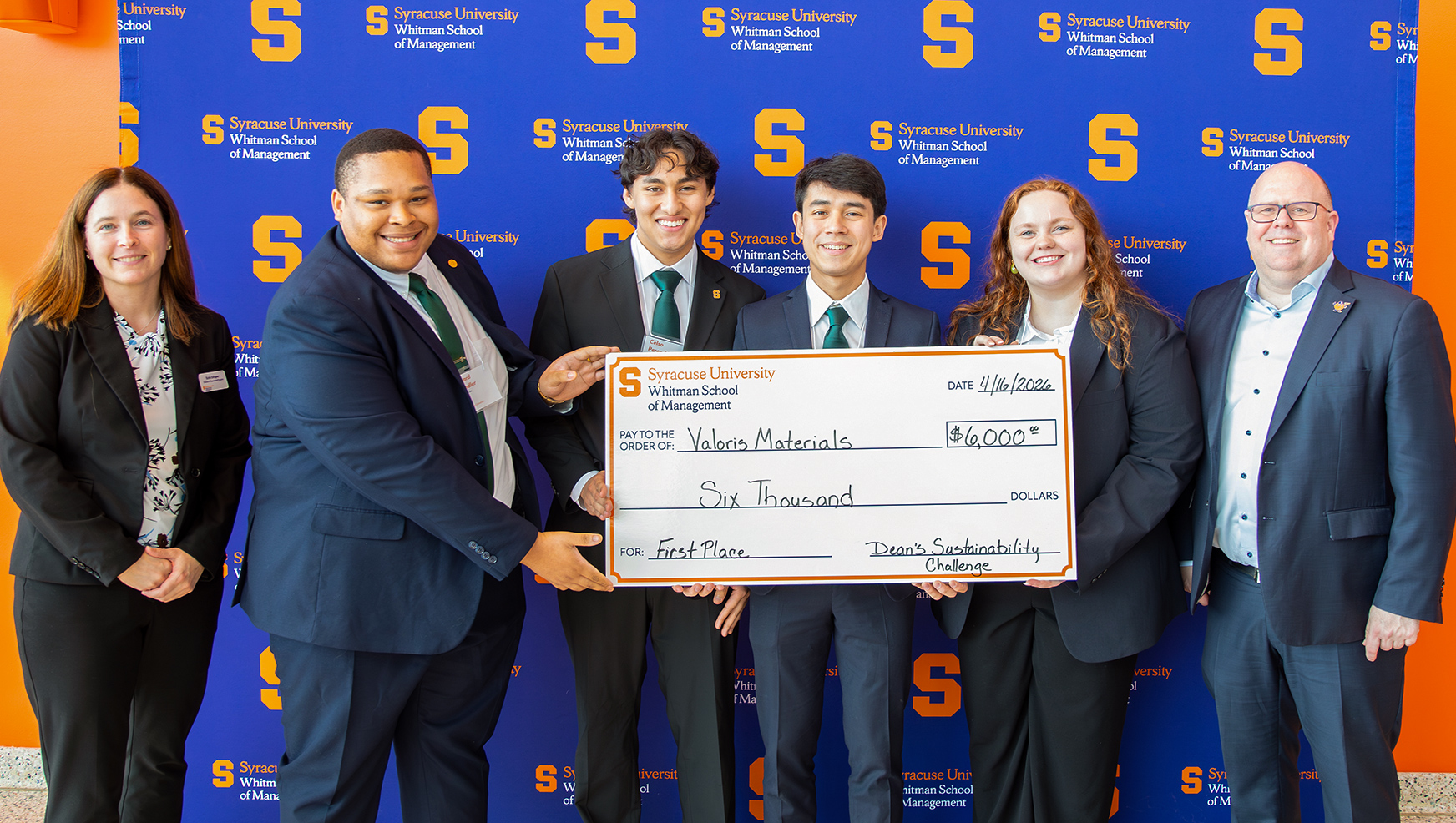
First Place: Valoris Materials—$6,000
Valoris Materials took home the top prize for SiliCrete, a stronger, greener concrete made from CMP sludge, a silica-rich byproduct of semiconductor chip fabrication. SiliCrete converts that waste stream into a value stream, producing concrete that is 22 to 38 percent stronger than standard Portland cement at a 10 percent substitution level and offsetting an estimated 7,000 metric tons of CO2 per year at full scale. The team physically built and tested prototypes, validating the concept beyond theory. The project addressed SDGs 9 (Industry, Innovation and Infrastructure), 11 (Sustainable Cities and Communities), 12 (Responsible Consumption and Production) and 13 (Climate Action). Team members included Richard Chandler ’27 MBA, Alexandra Perry ’25 (A&S), ’27 MBA, Jonah Komosinski ’25 (WSM/iSchool), G’26 (iSchool) and Celso Perez Mayo ‘25, ’26 M.S.
Second Place: CleanLeaf—$5,000
CleanLeaf earned second place for its AI-powered community wellness platform designed for universities and workplaces. Rather than asking users to download yet another app, CleanLeaf meets participants where they already are: users receive a message via WhatsApp, Teams or iMessage, tap a link and photograph their meal for automatic nutritional logging. Institutions pay for the platform and gain real-time outcome tracking and board-ready ESG reports tied directly to their sustainability goals. The team identified a critical gap—participation in corporate wellness programs averages just 7 to 21 percent of eligible employees—and built a low-friction solution targeting the $61.9 billion global corporate wellness market. Team members included Clarissa Karki ’27 M.S., Chris Kapsalis ’26 M.S., Tanvi Mahadik ’26 M.S. and Ecem Ipek ’26 M.S.
Third Place: TACTIQ—$4,000
TACTIQ claimed third place for its purpose-built electronic Braille reader designed for blind children ages 6 to 12 in under-resourced schools in India. Studies show that nine out of 10 blind children in the United States cannot read Braille, and in India—home to the world’s largest blind population—fewer than 1 percent of blind school-aged children are Braille literate. TACTIQ addresses the cost barrier by replacing expensive piezoelectric actuators with electromagnetic ones, significantly reducing the per-unit manufacturing cost. The device runs entirely offline and includes an on-device AI tutor pre-loaded with the Indian national curriculum. The project addressed SDGs 4 (Quality Education), 8 (Decent Work and Economic Growth), 10 (Reduced Inequalities) and 17 (Partnerships for the Goals). Team members included Anna Aaradhana ’26 MBA, Akriti Bhujel Chhetri ’26 M.S., Urvi Gosrani ’26 M.S. and Gurvir Shergill ’26 MBA.
Best in Show—1st Place: Everywear—$2,500
The first-place Best in Show award went to Everywear, a hyperlocal peer-to-peer clothing rental platform built for Syracuse University students. With New York State residents discarding nearly 1.4 billion pounds of textiles annually and clothing utilization declining 36 percent since 2000, Everywear offers a practical alternative: students rent underused clothing from one another through a trusted campus platform, reducing waste and lowering spending on occasion-specific outfits. The project addressed SDG 12 (Responsible Consumption and Production). Team members included Pranali Ramteke ’26 M.S., Nishant Bhagat G’26 (ECS), Sujay Pari ’26, Umer Faheem ’27 M.S. and Praveer Byndoor G’26 (iSchool).
Best in Show—2nd Place: Valoris Materials—$2,000
(See Valoris Materials above.)
Best in Show—3rd Place: CarbiFiber—$1,500
CarbiFiber received the third Best in Show award for its digital measurement, reporting and verification platform that quantifies the carbon-crediting potential embedded in everyday clothing. By integrating scannable tags into garments through brand licensing agreements, the app tracks each item's full lifecycle and rewards users for extending garment life through reuse, repair and resale as verified carbon savings, allowing them to participate directly in the voluntary carbon market. The project addressed SDGs 8 (Decent Work and Economic Growth), 9 (Industry, Innovation and Infrastructure), 12 (Responsible Consumption and Production) and 13 (Climate Action). Team members included Ava Lubkemann ’27 (ECS), Trey Augliano ’27 and Dylan Bardsley ’26.
Audience Favorite: Everywear—$2,000
(See Everywear above.)
Best Prototype: Valoris Materials—$2,000
(See Valoris Materials above.)
For more information, visit the Dean’s Sustainability Challenge page on the Whitman website.