


Spring 2026 Capstone Competition Celebrates Seniors’ Entrepreneurial Vision
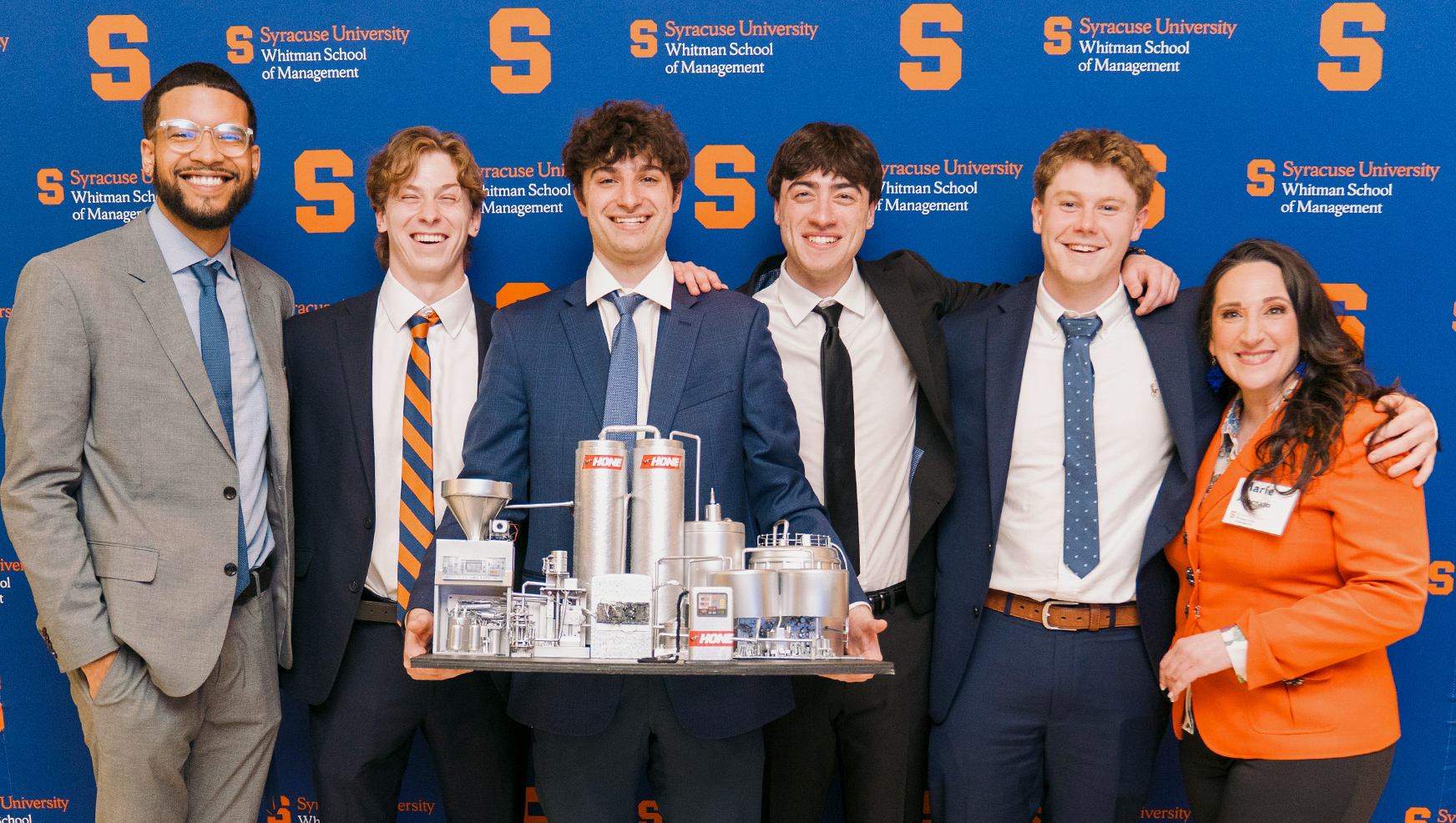
Fifty teams of Whitman seniors filled the school with energy on April 24 as the Spring 2026 Capstone business pitch competition brought another semester of innovation, teamwork and entrepreneurial thinking to life. From afternoon presentations to an electric final round in Lender Auditorium, the day showcased what Whitman’s Class of 2026 had been building all semester. When the scoring was complete, it was Hone Energy Systems—advised by Adjunct Faculty of Entrepreneurship and Emerging Enterprises Marie Adornato and created by Noah Thompson, Raymond Castillo, Nolan Adams, Adam Ormrod and McKinley Adin—that took first place.
Capstone is part of the Whitman School’s portfolio of signature experiential programs and serves as the culminating academic experience for seniors. Teams are challenged to develop a new product, service or business model with real-world potential, demonstrating how it creates economic value, a path to $3 million in revenue within five years and the ability to attract more than $100,000 in outside investment. Students present their ventures to alumni entrepreneurs, faculty and business professionals in a competition for top honors.
Throughout the morning, all 50 teams presented in rooms across the Whitman School, where judges scored each concept and selected room winners to advance. By afternoon, everyone gathered in Lender Auditorium to learn which 12 teams would compete in the final round. Representatives from each advancing team took the stage to deliver their three minute pitches to the panel of final-round judges: John Phillips ’97 MBA, Neil Rosenbaum ’88 MBA, Stacey Tank ’02, Tim Stitt ’15 M.S. and Rob Zaccaria ’21 MPA. The judges’ scores, combined with audience votes, faculty business plan scores and first-round judges’ votes determined the winners.
Adding a memorable moment to the afternoon, Whitman alumnus Seth Samowitz ’17—who won the Capstone competition nearly a decade ago with his company Busie—happened to be visiting campus and was invited to address the finalists. Samowitz reflected on sitting in those same seats nine years ago and shared the lesson he wished someone had told him: that the skills which truly compound over a career are storytelling, persuasion and passion. “Technical skills get you in the room,” he told the students. “Those three keep you in it.” His appearance gave the day an added sense of continuity, connecting the Class of 2026 to the long line of Whitman entrepreneurs who came before them.
First-place winner Hone Energy Systems earned top honors with an ambitious two-division venture targeting the agricultural energy market. At its core is the BioForge — industrial on-farm machinery that converts seed oils and agricultural waste into biodiesel, giving farmers a way to turn existing resources into fuel they can use or sell. The team’s second division functions as a fuel brokerage, connecting farmers directly with refiners and treating each machine as a node in a larger production network. The team pitched the concept as “the future of agriculture and energy,” pointing to a $60 billion U.S. diesel market growing at 2.5% annually. They asked for $1.5 million for 25% equity, projecting a 10.3x return with a $15.4 million base case.
"It was always our objective to serve our farmers as well as our environment. I need to express my gratitude to our fellow competitors, who have shown nothing but love for our project," says McKinley Adin ’26.
Thryve earned second place with a consumer health technology concept built on a 20-year license to NASA’s PUMA sensor technology. The team designed a handheld breath analyzer that captures more than 30 metabolic and respiratory metrics from a single breath and pairs with a mobile app that distills the data into three scores: Readiness, Metabolic and Cardio-Respiratory. The team positioned Thryve as an accessible alternative to clinical testing that currently costs $300 per visit with an average 31-day wait for a physician appointment. They asked for $675,000 for 30% equity and two board seats, projecting a 9.6x return on investment. Team members Ronan Hussar, Peter Colella, Marissa Hoinowski and Christopher Ianniello were advised by Professor of Entrepreneurial Practice Ken Walsleben.
Third place went to DrainGuard Tech, whose product GreaseGuard takes aim at one of the most common and costly household plumbing problems. The smart, enzyme-powered drain cap releases eco-friendly enzyme pellets on demand through a companion app to prevent grease buildup before it becomes a clog. The team asked for $800,000 for 30% equity and two board seats, projecting approximately $14 million in Year 5 revenue and an 18.2x return on investment. Team members Camryn Curow, Nicholas Lardieri, Thomas Patchell, Jason Cherepakhov Jr. and Gabrielle Marionni were also advised by Professor Walsleben.
Honorable mentions were awarded to Doe Diagnostics and PulseID. Doe Diagnostics, created by Ava Yustin, Abigail Mondin, Sydney McCawley and Sadie Potyk and advised by Professor of Entrepreneurial Practice Alexandra Kostakis, developed a toilet-integrated biosensor system that passively analyzes urine biomarkers during everyday bathroom use, providing continuous reproductive health insights including PCOS hormone tracking, ovulation prediction, pregnancy detection and UTI screening without manual testing. PulseID, developed by Jane Murphy, Matthew Raccuia, Stella Raichle and Allison Soulier and advised by Adornato, is a biometric authentication mouse for healthcare workers that uses each employee's unique ECG signature to replace passwords and badges with instant, secure identity verification.
“There is nothing quite like Capstone Day at the Whitman School—the hallways are buzzing, the ideas are bold, and you can feel the pride our students have in the work they've built over the past 15 weeks,” says Interim Dean Alex McKelvie. “Hone Energy Systems and every team that competed today reminded us why experiential learning is at the heart of a Whitman education. These students leave here not just with a diploma, but with the entrepreneurial mindset and real-world experience to make an impact from day one. I congratulate all of our participants, our winners and the faculty who guided them every step of the way.”
Business plan reviewers included John Torrens, professor of entrepreneurial practice and interim department chair of the Department of Entrepreneurship and Emerging Enterprises; John Petosa, professor of practice; Patrick Penfield, professor of supply chain practice and director of executive education and Lynne Vincent, chair of the Department of Management and associate professor of management.
Other judges who participated in the first-round portion of the competition included Anna Chernobai; Barbara Ashkin ’74, ’77 M.S.; David Ayoub; Christen Belcher; Ryan Benz ’11; Brittany Berry ’18; Nick Bonfardice '07; Charlene Bozzi ’15; Brady Cass; Jim D’Agostino ’01; Lee De Amicis; Jeff Eades ’85; Jeff Ellerton; Jordan Evans ’17; James Farrell ’19; Scott Fay; Patrick Griffin ’20 MBA; Janice Harvey ’85; Sam Holland ’23; Britt Jessica; Kara Jones; Tina Kapral G’15 (MAX); Mishael Kushkituah ’10; Jonathan LaSala ’12; Bill Leiker; Patrick Mannion; Brandon Mastrangelo; Anne Messenger; Joe Morgan ’15; Arielle Newman; Christie Novak; Furkan Oztanriseven; Jamie Pearce; Sarah Pelligrini ’04; TJ Perkins ’15; Rick Ranucci; Marybeth Riscica; Jeff Rogers; Julie Sheedy ’08; Anyware Sikochi; Stephen Smyk ’92; Zachary Sussman ’22; Jeff Thompson ’82, ’90 M.S., ’94 MBA; Mark Travis; Khrystyna Volytska ’12; Fred Vona ’11 MBA and Joyce Zadzilka.