The Class They Didn’t Want to Miss: Inside Whitman’s Entrepreneurial Marketing
The energy in Professor Elizabeth Wimer’s office is immediate. A few students have gathered to talk about their entrepreneurial marketing class, with others dropping by throughout the conversation “for the vibes.” They’re finishing each other’s sentences and trading stories about the semester.
This is the environment Wimer creates—what happens when you put students from Whitman, Newhouse and Falk together to work with a founder who is as invested in them as they are in her company.
This semester, Wimer’s EEE 482/682 students partnered with Paden Sickles, founder and CEO of SickFit, a woman-owned, veteran-owned performance sock brand posting 70% year-over-year growth. Sickles has built a company whose products have been worn by Olympic and Paralympic athletes and her podcast features guests like Mark Cuban and Dak Prescott.
So here’s the thing: she didn’t need the students’ help.
“I want to make really clear that she did not need our help,” Wimer says. “This wasn’t a situation where we were going to think of something she could never think of. But she was gracious enough to let us look inside her business and really get the full experience.”
What unfolded was something more valuable than a consulting project. It was a semester-long immersion in entrepreneurial practice, complete with feedback, activations and real relationships that left students rethinking everything from their career paths to their morning routines.
A Partnership Built on Trust
After years away from teaching entrepreneurial marketing, Wimer knew she needed a partner she could trust. She found that in Sickles, whom she’d met at Veteran Edge, an Institute for Veterans and Military Families event and stayed in touch with since.
What emerged was a collaboration that gave students something unique: a semester-long, genuine outside-the-classroom experience with a real business owner.
Marissa Cogan ’26, a broadcast and digital journalism major with an emerging sports enterprise minor, hadn’t directly connected with real-world business owners in her previous classes. “It’s always just been in-the-classroom stuff with my Newhouse classes,” she says. When she learned this course in Whitman would be different, she was excited.
Students divided into teams, each assigned one of SickFit’s core customer groups: healthcare workers, athletes and everyday doers whose performance depends on foot comfort. They conducted blind focus groups, developed SWOT analyses and pitched activation strategies.
A Founder Who Showed Up
But the real magic wasn’t just in the project structure. It was in how Sickles showed up for the students throughout the entire semester.
She appeared on Zoom in week four to reveal the brand and her story. She gave detailed feedback on their activation ideas before they executed anything. She stayed in touch, checking progress and offering guidance. And in late March, she flew to Syracuse.
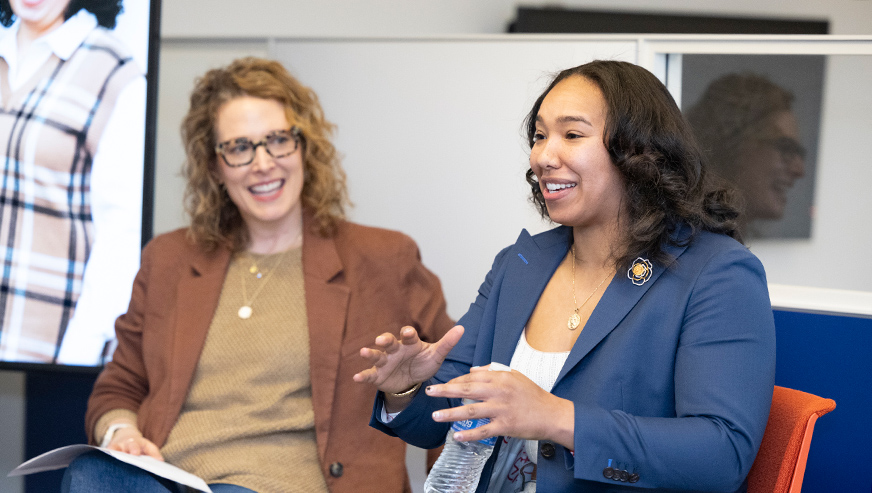
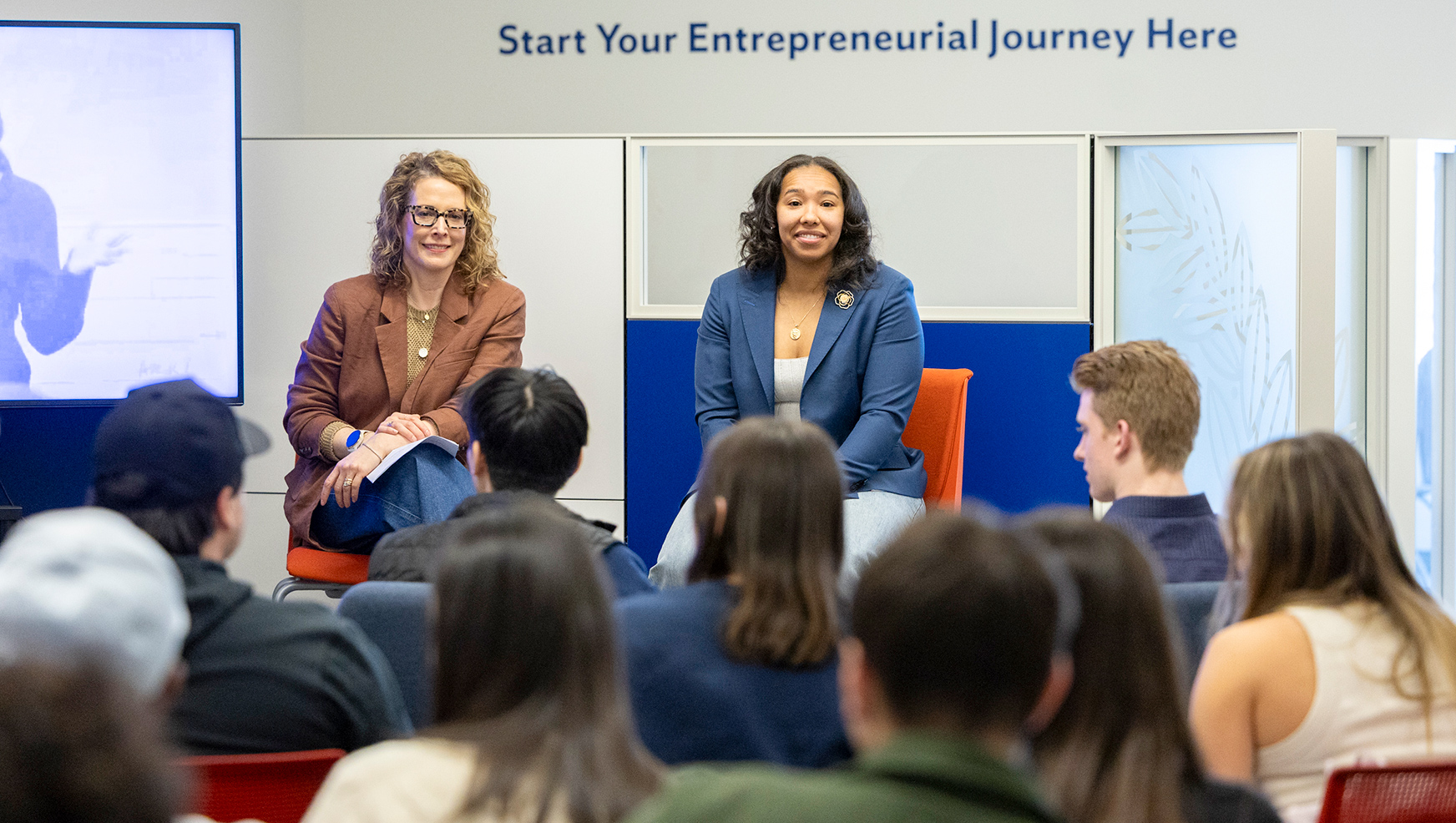
Sickles speaking to Whitman students at the Couri Hatchery Student Business Incubator
That week became the centerpiece of the semester. Sickles attended team activations, giving real-time feedback as students tested their strategies. “It felt like Paden was so invested in the class and us, almost like a secondary professor,” Cogan says.
For Lars Jendruschewitz ’27 (WSM/NEW), an entrepreneurship, marketing and visual communications major who also runs his own photography business, the fireside chat was transformative. “The key nuggets that she dropped, and she probably didn’t even know that she was doing it,” he says. “It’s so helpful to have someone that’s a few years ahead of you and that knows the phases you’re going through.”
Lessons That Stick
The partnership taught students lessons they didn’t expect, starting with the simplest one: even everyday items have potential for innovation and success.
“I’ve taken for granted all the things I don’t have to think about,” Cogan says. The class made her start questioning her purchasing decisions, even for everyday items like socks and water bottles.
For Jendruschewitz, the experience reframed how he sees brands. “You go through the grocery store and you see tens of thousands of brands there and every single one has a story just like Paden,” he says. “Paden had blisters all across her feet, which led her to making socks. I was working with a founder whose child had 23 food allergies, so she made an everything-free nut bar. Seeing those stories is really impactful and is making me regain some hope in business.”
That shift in perspective matters. “Paden was incredible and made me realize that you don’t need to be an awful person to run a successful company,” Jendruschewitz says.
The Energy in the Room
Perhaps the most striking outcome wasn’t captured in any activation report. It was the bonds formed between students who might never have worked together otherwise.
The class brought together students from Whitman, Newhouse and Falk. They were technically competing, but something else happened.
“Even though we were broken into groups, we would mix and mingle and all got to know each other so well,” Cogan says. “It was a group made up of class clowns and class icons and we all got really close. Then Paden came in, got the vibe right away and fit right in. There was a memorable balance between personal and professionalism.”
One moment captures that dynamic perfectly. During Sickles’ campus visit, students participated in a blind sock pitch competition. “It was intimidating but fun,” Cogan says. “I did win, though.” “That was my favorite day too,” Jendruschewitz jumps in, “because Marissa was on my team and won it for me.”
Aidan Mulligan ’26 (VPA), a communications and rhetorical studies major and sport management minor, learned that marketing isn’t about grabbing one easy idea. “You see how everyone’s opinions and various factors make an impact and change the trajectory of an idea,” he says.
What Makes It Work
As the semester wrapped, students delivered activation reports and scale-up roadmaps to SickFit, but there were clear lasting impacts. Cogan now wears SickFit socks daily. Jendruschewitz is applying lessons about team-building to his own business. Multiple students signed up for entrepreneurial marketing without even knowing what they’d be working on.
“I signed up for it just because her [Wimer’s] name was on it,” Cogan says.
The devotion isn’t misplaced.
“None of this would be possible without Professor Wimer,” Cogan says. “She has set up everything for us. Plus her connection to Paden and her ability to help Paden connect with us on a more personal level, that’s what good professors do.”
The result is a class where missing a session feels like a genuine loss. “When you miss class, it’s heartbreaking,” Cogan says. “Not only because of the attendance policy, but also because you’re like, ‘I wonder what I’m missing out on.’”
These are the environments that define a college education. Not the lectures or the exams, but the collaborations that turn classmates into colleagues and projects into passion. The experiences that make students voluntarily gather in a professor’s office long after the semester ends, still finishing each other’s sentences.