


Five Takeaways That Make an Impact: ŌURA Health CMO Doug Sweeny ’90 on Building a Brand People Trust
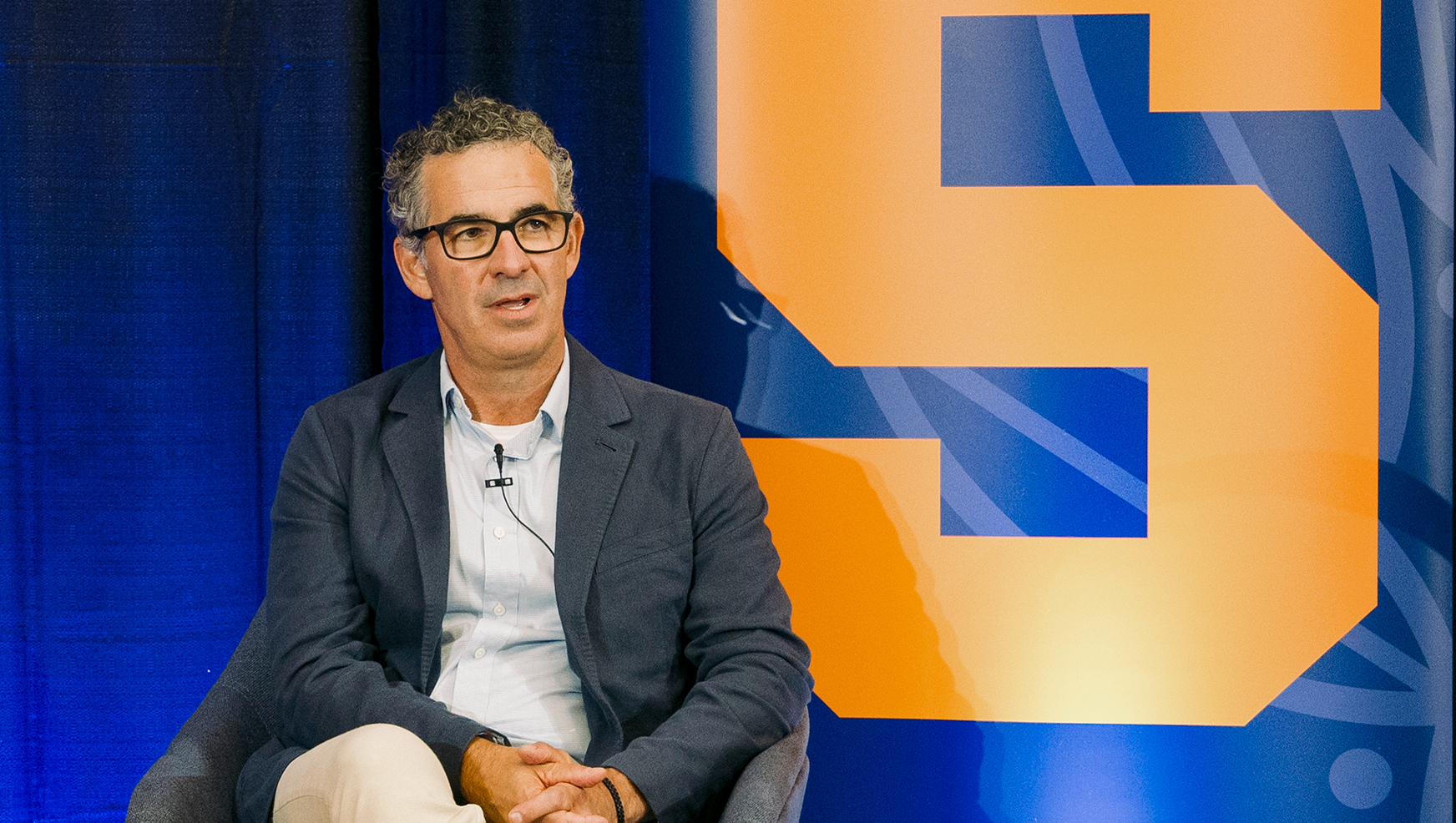
Doug Sweeny ’90 did not leave Syracuse University with a plan. What he built instead was a career across some of the most recognizable brands in marketing. Sweeny is chief marketing officer of ŌURA Health, where he leads global marketing, consumer revenue, membership and brand strategy for the maker of the ŌURA Ring. Before that, he helped scale Nest from startup to Google acquisition, led marketing at One Medical through its IPO and acquisition by Amazon, architected Levi’s “Go Forth” campaign and oversaw Adidas’ “Impossible Is Nothing” platform at TBWA\Chiat\Day. He also led marketing for General Motors’ pioneering electric vehicle, the EV1, and has been recognized on Forbes’ Top 50 CMOs, Business Insider’s Top 20 CMOs and Ad Age’s Tech Power List, among other honors.
Sweeny returned to the Martin J. Whitman School of Management on Oct. 8 for a fireside chat with Interim Dean Alex McKelvie as the first IMPACT Speaker of the 2026-27 academic year. The series began in 2024 and was created to build bridges between Whitman students and global business leaders. Over the course of the conversation, Sweeny was open about the career turns and lucky breaks along the way. He discussed the thinking behind one of the fastest-growing brands in wearable health and the habits that separate the candidates who land the offer from the ones who don’t.
Here are five takeaways from the conversation:
The path is rarely straight, but the right network helps you find your way.
Sweeny started where many students are right now, with a big question mark. After graduation, he had no idea what came next and followed college friends to New York City. What opened the door was a fellow Syracuse alumnus, about 10 years ahead of him and a stranger at the time, who responded after Sweeny sent out 20 or 30 letters and helped him land the job. It was the Orange network at work, and a lesson Sweeny clearly took to heart.
From there, he kept choosing growth over comfort. “It is a marathon, not a sprint,” he said. He and his wife, Charlotte Murphy Sweeny ’89 (NEW), took a leap of faith after four years in New York, picking San Francisco as their next adventure. He later crossed from the agency world to Levi’s, betting on new skills in public relations and digital. Then came a deliberate pivot into technology as his career took him to work for Nest, One Medical and, in 2022, ŌURA.
Great brands start by listening.
Sweeny’s starting point at ŌURA was humbling. Awareness sat around 5%, the business was roughly 90% direct-to-consumer and the ring was known mainly as a sleep tracker. When he asked about brand health during his interviews, he got “blank stares,” and each leader he asked about the company’s mission gave a different answer.
Four years later, the picture looks very different. U.S. awareness has climbed to roughly 44%, the ring sits on shelves at Target, Costco, Walmart and Best Buy, and what started as a sleep tracker has grown into a full wellness product. Sweeny credits a process he has refined over decades: listen to consumers, study the culture, get the leadership team aligned in a full-day working session and then make the case to the whole company.
What came out of it was a simple idea. “ŌURA, at its core, is a listening device for your body,” he said, a truth teller that turns what your body is saying into something you can act on. That thinking evolved into the tagline “Give everybody a voice,” and has guided the brand ever since.
A clear brand idea can tell many stories, but trust makes them stick.
That clarity is what lets ŌURA tell different stories for different goals. When women said the ring felt too big, engineers spent two years shrinking it to about 40% of the size, and the ŌURA Ring 5 campaign, built around “subtle power,” followed. Partnerships like Team USA, meanwhile, are less about selling a ring and more about showing ŌURA as a leader in performance.
The newest campaign, which launched the morning of Sweeny’s conversation at Whitman, goes a step further. Sweeny called it “a product ad wrapped in an emotional brand execution,” and the aim is connection, because a company that holds so much personal health data must earn people’s trust.
The biggest growth is still ahead, and it is powered by people.
Even after four years of progress, ŌURA is still introducing itself to the world. “Our business today is still in very, very early innings,” Sweeny said.
Much of the growth so far has come from people rather than ads. About 40% of customers say a friend, family member or co-worker introduced them to the ring, and partnerships with companies like American Express and Lululemon are widening that circle. A quick show of hands in the room put ownership at about 30%, more than Sweeny expected and a good sign with the next generation of customers.
Those customers increasingly include women, the company’s fastest-growing audience. Sweeny traced that shift to the product itself. ŌURA once skewed toward male “biohackers” with a bigger, less discreet ring, but a dedicated women’s health team has since built features like cycle tracking, and women, he noted, tend to be the “quarterback” of their family’s health. Looking ahead, he expects the next chapter to look more like healthcare.
Earn the offer: preparation and persistence get you in the door.
Students came with a practical question for Sweeny: how do you actually land the job? Sweeny shared that once you get an interview, preparation is everything. Know the brand, understand its competitors and arrive with real questions, because “No, I’m all good” is not how you want to close the conversation.
He pointed to his own interview with Tony Fadell at Nest, when he was asked what he would do as vice president of marketing. Sweeny spent a whole weekend writing a white paper, had it professionally designed and turned it in before Monday morning. It worked, and he got the job. His closing advice was to treat the search itself like work: keep “a lot of irons in the fire,” he said, and approach the job hunt like a full-time role. At the end of the day, Sweeny’s message came back to listening: to your customers, your network and what your own career is telling you. Like the ring he markets, his advice was less about one big moment than about paying attention to the data you generate every day and acting on it.
At the close of the fireside chat, students had the chance to network and interact with Sweeny one-on-one, putting his advice to use in real-time.