


Four Lessons in Lasting Impact: Goldman Sachs’ Jeffrey Scruggs on Building Meaningful Relationships and the Long Game of Leadership
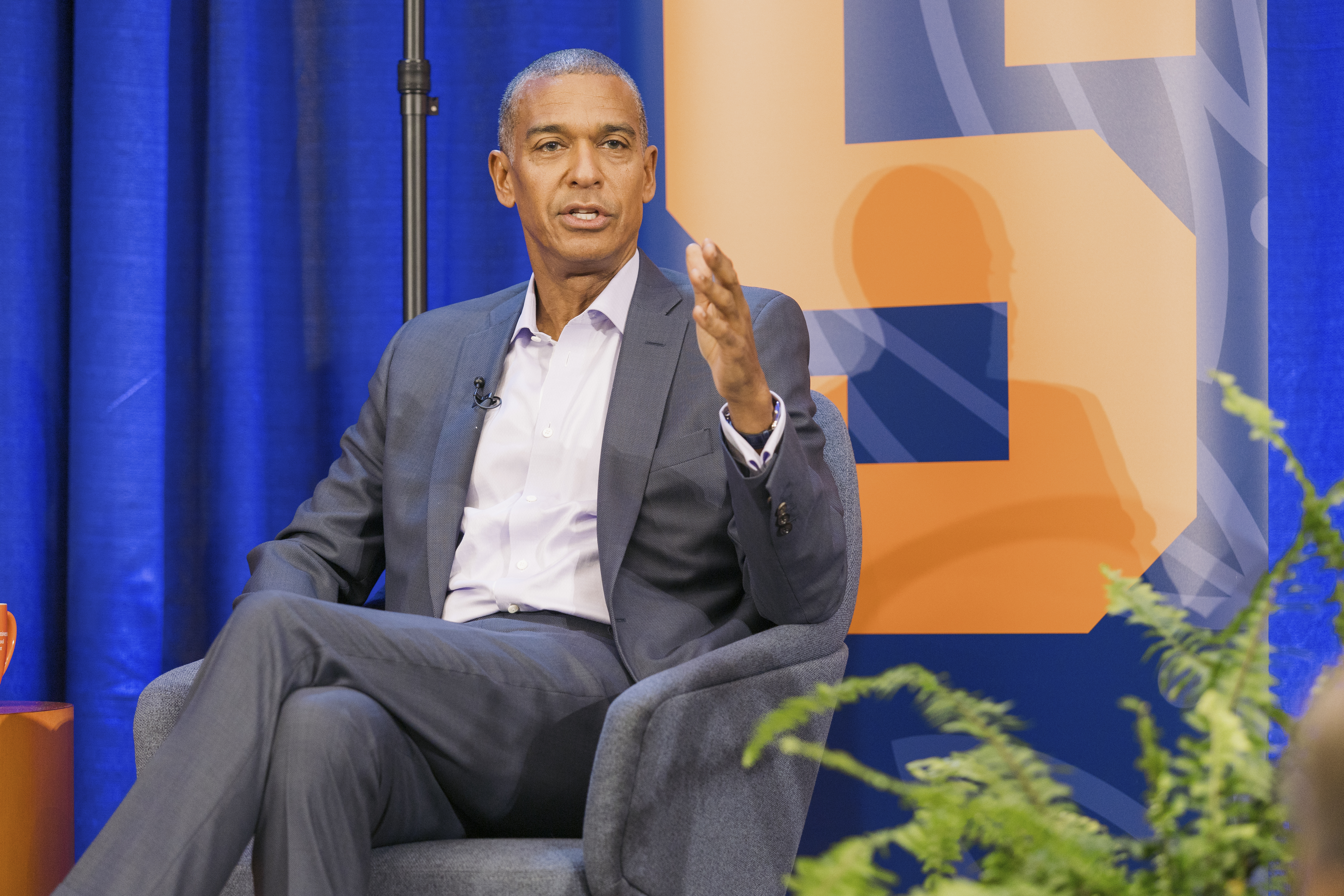
For just under 10 years, Jeffrey M. Scruggs has served Syracuse University as a voting trustee and later Chairman of the Board of Trustees. In addition to this storied tenure on campus, Scruggs is an established leader in finance and banking whose decades of experience have shaped how he approaches leadership, risk, and opportunity. As the second IMPACT Speaker of the 2026-27 academic year, he shared that hard-won perspective with Whitman students in a conversation moderated by interim dean Alex McKelvie.
Scruggs’s connection to Syracuse runs deep. He grew up just two miles away, a product of Nottingham High School, in a household where the University was part of daily life: his father, Otey, served for 25 years as a Maxwell School faculty member. Decades later, he is still giving back to the place that shaped his upbringing. Scruggs has been involved with the Maxwell School Advisory Board since 2017, and he and his wife, Robin Mitchell, have established scholarships in honor of his parents, creating opportunities for countless students. Their generous support also extends to the Barnes Center at the Arch and Syracuse University Athletics.
His professional accomplishments are equally distinguished. Scruggs joined Goldman Sachs in 2008 and led its public sector and infrastructure banking department for 17 years, and he remains a senior banker and chairman within the group. Earlier in his career, he managed the sale of the U.S. Department of the Interior’s $700 million loan portfolio and rose to managing director at PaineWebber, which later became UBS. A two-time Harvard graduate, he also serves on the board of the NHP Foundation, which has invested more than $3 billion in affordable housing across the country.
Over the course of the conversation, Scruggs pulled back the curtain on the infrastructure financing that keeps communities running, how he earns the trust of clients and what he looks for in the next generation of professionals.
Here are four lessons he shared with the Whitman community:
Trip into the opportunity you never saw coming.
Scruggs is the first to admit that his career was not mapped out in advance. He studied economics at Harvard, though history was his true passion, and he had no master plan for Wall Street. A summer program for minority students, Sponsors for Educational Opportunity, placed him at PaineWebber, in a public finance department he knew nothing about. “I didn’t know Wall Street from Main Street,” he admitted. He returned the next summer and then joined the firm full-time as an analyst.
As his two-year analyst program was winding down, Scruggs had a perfect plan: Stanford Business School, with friendly roommates lined up and a house ready to rent. On what was supposed to be his last day, his former boss, then a presidential appointee at the Department of the Interior, asked him to come to Washington and run a program.
The decision put him in charge of selling a federal loan portfolio worth $700 million at just 22 years old. “That was the first time somebody said, you’re in charge,” he recalled. It taught him what it means to own a responsibility, and it prepared him for the demands of winning business.
His message to students was that “a lot of stuff happens by happenstance,” and the skill is recognizing the moments you trip into and taking advantage of them. When someone offers you the chance to lead, take it, he said, because you gain experience at an age when “a mistake is not a tragedy.”
Great leaders look after their people.
When UBS dismantled his department during the 2008 financial crisis, Scruggs was asked to stay on while it wound down. With about 150 bankers on his team, he made finding them new jobs his first priority. For Scruggs, that is the real measure of a leader. Your team doesn’t just report to you; they work with you, and caring for them comes before anything else. Do it well, and the respect and loyalty will follow.
That same commitment shaped how he approached his own exit from Goldman Sachs years later. A leader, he said, should start thinking about a successor the moment they take charge. After co-heading the group for 13 years, Scruggs named two co-COOs and gave them five years to grow into the role. When he stepped back this past February, his successor was ready. “If you haven’t groomed your successor, you haven’t done it right,” he said.
Trust is built by meeting people where they are.
In a business where clients entrust bankers with billion-dollar decisions, relationships are everything. Scruggs’s approach to relationship building starts with listening. Before talking about yourself, he believes it is important to learn what a client cares about. It also takes time. The deals worth winning rarely come quickly, and a new relationship can take years to turn into business. “Patient capital is key,” he said, and the bankers who earn the next opportunity, “are the ones still around when the door finally opens.”
Trust is also tested when things do not go your way. Scruggs recalled an early-career setback: the District of Columbia, a longtime client and a city close to his heart, did not select his team for a pool of firms that would handle its deals. It landed, he said, “like a 2x4.” He could have complained to colleagues or to the client, but he knew neither would help. Instead, he picked himself up and doubled down, and within a year he had found a way back in.
“A banker who wins four of every 10 deals he chases is a Hall of Famer, but only if he can handle the other six.”
Talent opens the door. Character keeps it open.
When evaluating talent, Scruggs said, he can take the fundamentals for granted. He expects smart, driven candidates with a strong quantitative foundation. But what he really looks for goes beyond the résumé, and it is what separates good candidates from great ones.
He wants someone who can juggle several projects at once, who is easy to work with and who is truly inquisitive about the work. A summer internship is where this shows. “Over nine weeks,” he said, “it becomes clear who is engaged and who is simply going through the motions.”
Scruggs shared that standing out comes down to three habits: work hard, respond quickly to anything asked of you and be someone people want around. Senior people size you up fast, often before you can show how smart you are.
Scruggs’s closing advice was about the long game. “Take risks while your options are widest—while you still have a 2-handle on your age. Welcome mentors who come into your life naturally and listen when they counsel patience. Keep choosing work that challenges you, at any age. Talent may open the door, but it is curiosity, humility and a willingness to keep growing that hold it open.”
After an hour of candid stories and practical advice, students lined up to meet Scruggs in person, learning a few new lessons and leaving with a connection to grow their network.