

Whitman School Presents Prestigious Salzberg Medallion, Showcases Leaders in Supply Chain at Annual Lecture Program
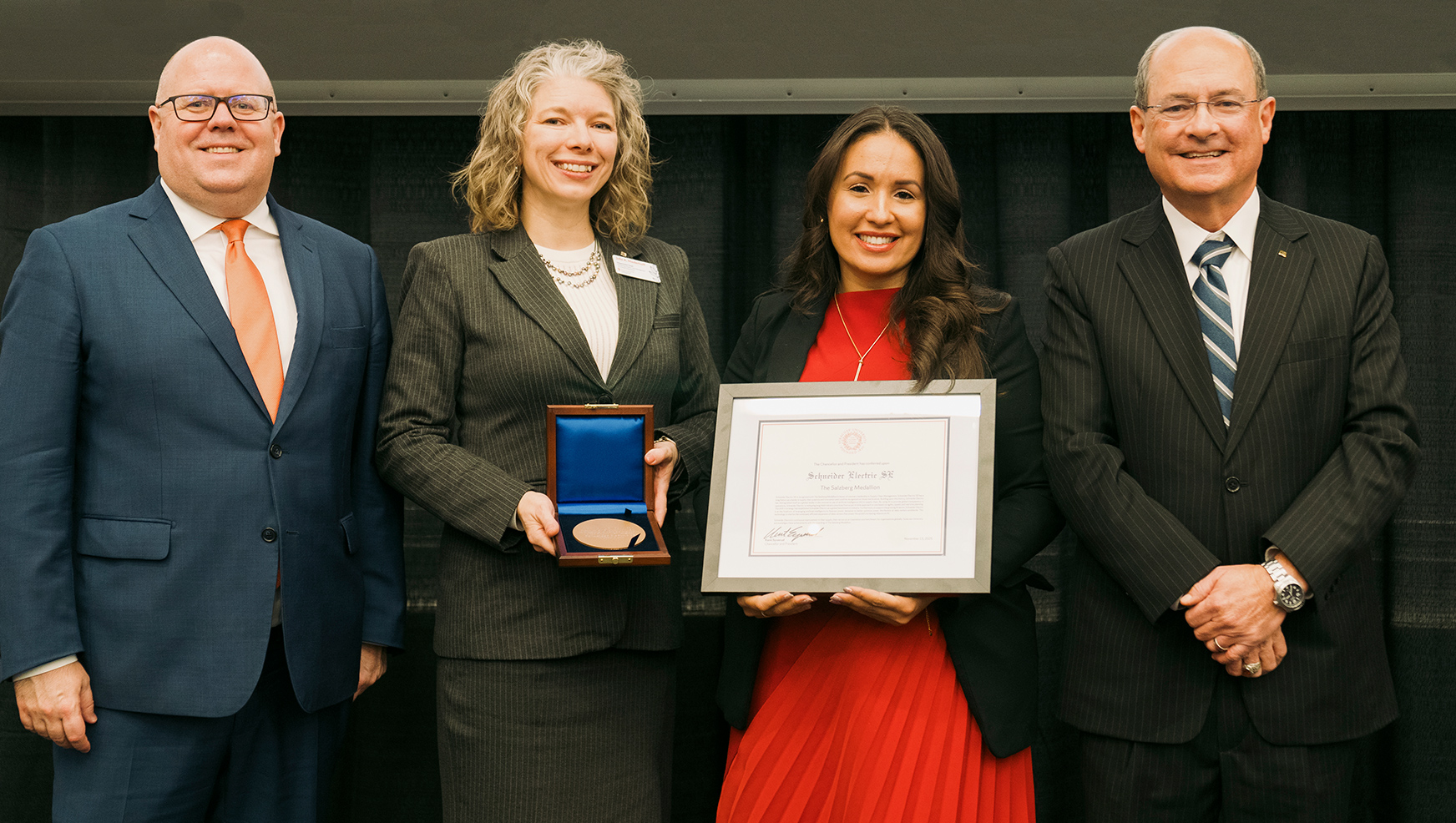
Alex McKelvie, Julie Niederhoff, Cyre Denny ’11 (MAX) accepting the he Salzberg Industry Medallion on behalf of Schneider Electric SE, and Gary La point.
The Whitman School of Management held the 76th Annual Harry E. Salzberg Memorial Lecture Program on Nov. 13 in Lender Auditorium, welcoming top leaders in the supply chain and transportation fields who are fostering research and best practices in this space. Open to Whitman faculty, staff, students and guests, the event was highlighted by the presentation of the coveted Salzberg Medallion, one of the premier awards in the field since 1949.
In addition, several other awards were presented to students doing outstanding work in supply chain management, followed by four presentations on timely topics in transportation and supply chain by three highly-regarded thought leaders in the field and a group of exceptional Whitman students.
Made possible by the support of Whitman’s H.H. Franklin Center for Supply Chain Management, this year’s Salzberg program was co-directed by Professor of Practice Gary La Point and Associate Professor Julie Niederhoff, both faculty members in the supply chain program.
“The Salzberg program is truly a special event for the Whitman School of Management and our supply chain management program,” said Whitman Interim Dean Alex McKelvie, who welcomed those in attendance. “Over the past 76 years, the Salzberg Medallion has become one of the most prestigious awards in the field of transportation and supply chain management. This event showcases industry leaders, our talented students and our outstanding scholars, as we celebrate the excellence of our nationally ranked supply chain management program. It recognizes innovators and those willing to take a stand for what they believe in, rather than simply accept the norms. This is the way that we’ve always done things here, and these are the type of values that we want to instill in our students.”
Salzberg Academic Medallion Presented to MIT Scholar Tracking Evolution of Operations Management
This year’s honorees were selected through a nomination process by past award recipients and others highly regarded in the fields of supply chain and transportation.
The 2025 recipient of the Salzberg Academic Medallion was Georgia Perakis, Ph.D., William F. Pounds Professor of Management, professor of operations management and operations research and statistics, Massachusetts Institute of Technology (MIT) Sloan School of Management; and visiting scholar, Harvard University Business School.
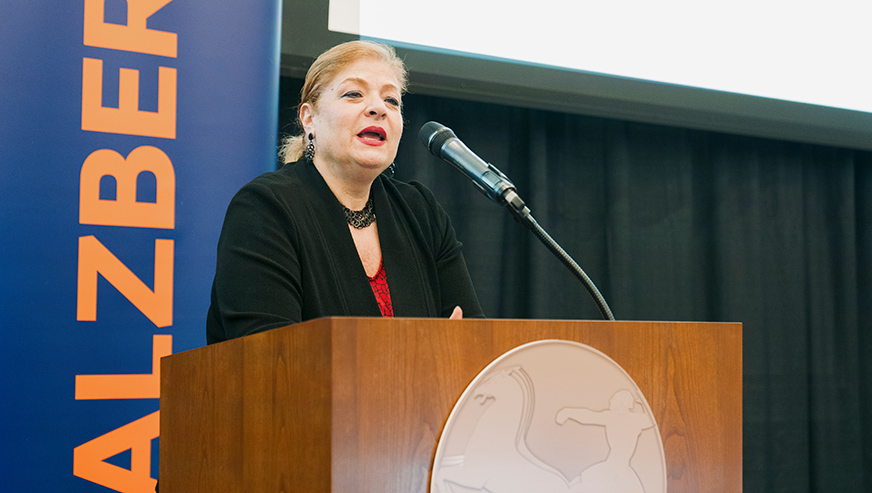
Georgia Perakis
Perakis has a bachelor’s degree in mathematics from the University of Athens, as well as a master’s degree and Ph.D. in applied mathematics from Brown University. She is the editor-in-chief of the Manufacturing and Service Operations Management (M&SOM) journal and has served on the editorial board of a number of other journals. Her award-winning research focuses on analytics and artificial intelligence (AI), specifically the intersection of optimization and machine learning (ML) with applications in pricing, revenue management, supply chain, sustainability and healthcare. In 2016, she was elected as an INFORMS fellow and in 2021 as a Distinguished M&SOM fellow. Perakis is the co-director of MIT’s Operations Research Center and a faculty affiliate of the MIT Initiative on the Digital Economy. She has been tracking the evolution of operations management from its earliest days.
Elodie Adida, professor of operations and supply chain management at the University of California-Riverside, a former student of Perakis, presented her with the award.
Salzberg Industry Medallion Presented to Trusted Partner Using AI to Reshape Supply Chain Strategies
The Salzberg Industry Medallion was presented to Schneider Electric SE by Cyre Denny ’11 (MAX), strategic account executive, cloud and service provide and service segment, at the company, who also accepted the medallion.
Schneider Electric creates impact by empowering all to make the most of energy and resources, bridging progress and sustainability for everyone—something it calls “Life Is On.” The company’s mission is to be a trusted partner in sustainability and efficiency, as it is a global industrial technology leader bringing global expertise in electrification, automation and digitization to smart industries, resilient infrastructure, future-proof data centers, intelligent buildings and intuitive homes. Through AI innovation, Schneider is reshaping supply chain strategies, shifting from the long-held practice of just-in-time concepts to ability, speed and real-time planning.
Undergraduate Awards Given to Whitman’s Future Supply Chain Leaders
Several Whitman undergraduate students majoring in supply chain also received awards at the event. Each award has its own process of selection focusing on student achievement and engagement in understanding supply chain challenges.
Odette Sherk ’26 (WSM/MAX) was presented with the Brethen Scholarship Award for her submission on AI in supply chain management by Whitman Management Professor Burak Kazaz, director of the Robert H. Brethen Operations Management Institute, The Steve R. Becker Professor of Supply Chain Management, and The Laura J. and Douglas Meredith Professor of Teaching Excellence.
Sherk and Deedra Samuel ’26 received the Awesome Excellence in Education Scholars award from the Achieving Women’s Excellence in Supply Chain Operations Management and Education. Each year, the organization asks a select group of colleges and universities to nominate just two students and, of those, only 20 are selected. This was the first time that both of Whitman’s nominees were chosen as Awesome Scholars.
Sherk also received the Zinsmeister Award, a scholarship for an outstanding undergraduate student in supply chain management based on GPA, internships and leadership. It was presented by Professor La Point.
Yuki Zhang ’27 was presented with the Empowering Women in Supply Chain Award presented on behalf of the Didier Family by Jorie Didier Fox ’10, director of logistics for Horizon Organic.
New this year, eight Whitman seniors in the supply chain management program were honored as H.H. Center Supply Chain Scholars for their excellence, both academically and experientially, through leadership across campus, actively seeking out challenges like case competitions and serving as peer mentors, volunteers and more. The recipients were Gabrielle Ho ’26, Kaitlin Bo long ’26, Anabel Patino ’26 (WSM/MAX), Deedra Samuel ’26, Dapeng Shen ’25, Odette Sherk ’26 (WSM/MAX), Sutton Thomas ’26 and Eric Zaks ’26.
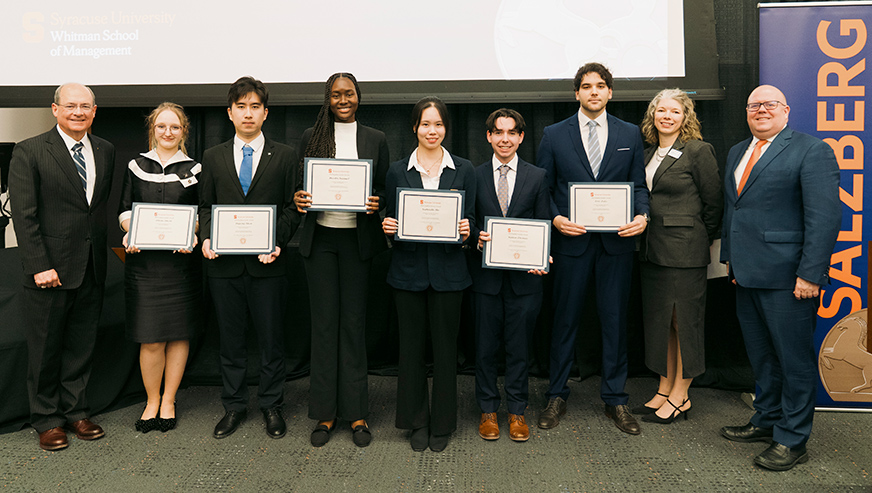
Gary La Point, Odette Sherk, Dapeng Shen, Deedra Samuel, Gabrielle Ho, Sutton Thomas, Eric Zaks and Alex McKelvie.
Experts Address Current Topics in Supply Chain Management
Thoughts on the Role of AI in the Field of Operations Management
Following the awards, Perakis presented Thoughts on the Role of AI in the Field of Operations Management, speaking about how AI is reshaping the fundamental principles and practices of operations management itself. She explored the critical question of how analytics-driven optimization, dynamic pricing and supply chain management has influenced companies from retail to healthcare in making critical operation decisions.
Perakis also shared her insight on how AI is not just automating processes but fundamentally reimagining what’s possible in operations management, while also stressing the importance of integrative, generative and adaptive work, not just faster decisions but smarter and adaptive decisions for better ecosystems.
Beyond the Hype: The State of AI in Transportation Management
Adrian Gonzalez, president, Adelante SCM, presented Beyond the Hype: The State of AI in Transportation Management at the event. He noted how the transportation and logistics industry is changing rapidly due to AI and provided information on research his company completed in partnership with Uber Freight, surveying high level logistics executives on where they currently stand with AI in the workplace.
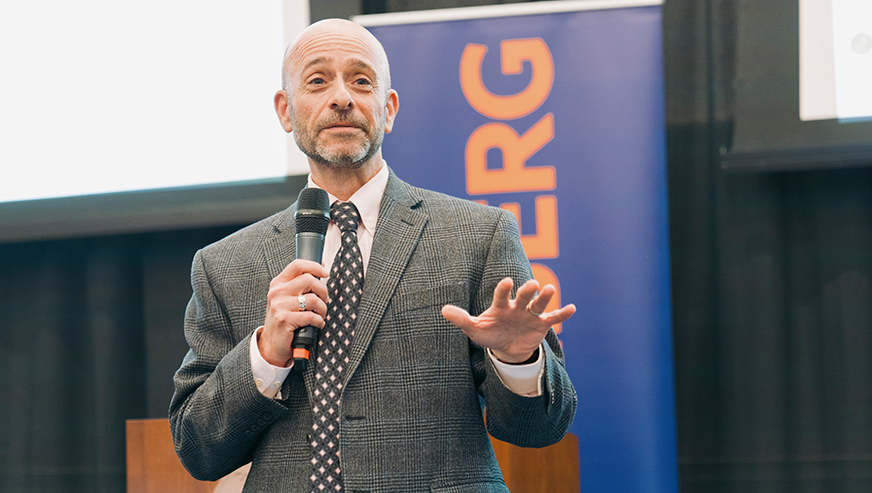
Adrian Gonzalez
According to this survey, only 12% said they were using AI consistently, while the majority said they need more education in how it could impact their business or were skeptical of the technology all together.
Gonzalez compared AI to the introduction of the internet, email and even social media—all of which were viewed with hesitancy at first, but today are commonplace in business. He also addressed the idea that AI will replace jobs moving forward.
Re-Routing: A “Training” Exercise
Whitman students from the Franklin Supply Chain Club, an organization dedicated to offering students interested in supply chain opportunities outside of the classroom presented on the railroad industry in the U.S. The students included Declan Gillan ’27, Gabrielle Ho ’26, Aira Polamreddi ’26 and Odette Sherk ’26.
The presentation gave an overview of the railroad industry in the U.S., highlighting the passage of the Interstate Commerce Act in 1887, which placed heavy regulations on the railroad industry through to the 1980 Staggers Act, which deregulated the industry. It also emphasized that profits are in moving freight versus moving passengers with the profit from freight totaling over $20 billion annually today and government-operated passenger travel actually operating at a loss. Other topics included discussion on the Union Pacific-Norfolk-South Southern merger, creating the first true transcontinental railroad owned by only one railroad company in the U.S. and the benefits and challenges that brings, as well as how the U.S. is one of the world leaders in moving freight by rail, along with China and Russia, but lags in terms of speed, as it is not a priority in the country.
According to the presentation, rail transportation is more cost efficient and three times less expensive than trucking and over 12 times less expensive than air freight. Rail transportation is also more fuel efficient and is looking into the use of biofuels.
“Rail was the past, but it should also be the future,” concluded Sherk.
Fireside Chat on New Opportunities in U.S. Railway
The last segment of the day was a fireside chat between Jason Seidl ’93, managing director of T.D. Cowen, a New York City analyst firm; and Paul D. Tonsager, partner and principal consultant with Integrated Multimodal Solutions, who has 30 years in the rail and global supply chain industry and is often called on as a strategic advisor. These transportation experts discussed the proposed merger between the Union-Pacific and the Northern Southern Railroad.
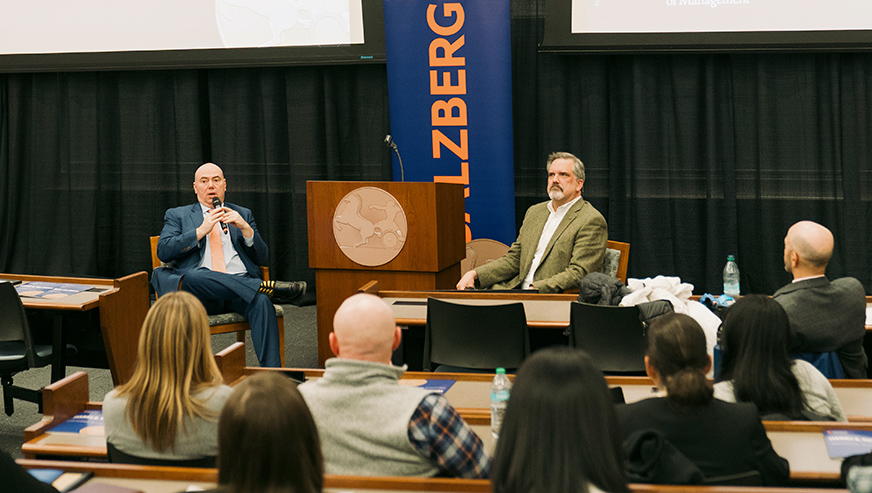
Jason Seidl and Paul Tonsager
“The railroads have done a very poor job of growing in the U.S.,” says Tonsager. “I’ve seen the whole picture here, and when you’re negotiating with railroads there are a lot of things to consider. But I’m in support of it. From an intermodal and a customer perspective, I look at it pretty positively. This is good for the industry.”
For more information on the Salzberg event, visit the Whitman School website.