

Undergraduate Majors
The Whitman School offers nine undergraduate business majors.
Each student in the Whitman School is required to complete one major field of study. You will have two years to explore your options and select the major (or multiple majors) that best fits your interests.
Whitman students have the opportunity to take two complementary business majors, while adding minimal credits to their program.
Undergraduate Programs







Dual Programs
The Whitman School offers the chance to earn a dual major, which allows students to pursue two programs of study in different schools at the University at the same time.
- School of Information Studies
- College of Arts and Sciences/Maxwell School of Citizenship and Public Affairs
- S.I. Newhouse School of Public Communications
- College of Law
Experiential Learning
The Whitman School creates and facilitates experiential programming that bridges the gap between classroom learning and practical application — all while expanding job placement opportunities and helping students build meaningful connections.
Clubs and Connections
You can meet and network with students and professionals who share your business and entrepreneurial interest by participating in our approximately 17 student clubs and organizations.
Student Profiles
Building With Purpose: Peter Ostrow ’26 MBA Finds His Path at the Intersection of Sustainability and Supply Chain Management
Peter Ostrow ’26 MBA
MBA, CASSE
- Full-Time
Learning from different perspectives helped broaden my understanding of how sustainability operates within business practices and beyond.
When Peter Ostrow ’26 MBA arrived at the Whitman School, he knew he wanted to strengthen his business credentials. What he did not yet realize was how deeply sustainability would shape his academic path and his vision for the future.
Now an MBA candidate in his final semester, Ostrow is concentrating in supply chain management while also completing the Certificate of Advanced Study in Sustainable Enterprise (CASSE). In spring 2025, he was named the recipient of the David M. Herskovits CASSE Fund Scholarship, an award supported by the David M. Herskovits Foundation that recognizes students committed to advancing sustainability through business leadership.
For Ostrow, the recognition reflects a journey that began with an openness to new possibilities.
A native of Wappingers Falls in New York’s Hudson Valley, Ostrow earned his undergraduate degree in marketing and management from SUNY New Paltz in 2022. Like many recent graduates, he found the job market challenging. “I wanted to stand out and decided to become a more well-rounded applicant,” he says.
He was attracted to Syracuse University for its strong sense of community and reputation in business education.
It was only after enrolling, however, that Ostrow discovered CASSE—a program that would significantly reshape his academic experience and career interests.
Housed at the Whitman School, CASSE is designed to prepare students to integrate sustainability into enterprise decision-making across industries. The program brings together students from business, environmental science and public policy, emphasizing interdisciplinary collaboration and real-world application. For Ostrow, that interdisciplinary approach proved transformative.
“I didn’t know what to expect from the CASSE program,” he says. “I was surprised—in a good way—that it included more than just business material; there was also a lot of science, policy and law integrated that standard business courses don’t highlight.”
Through courses shared with students from the SUNY College of Environmental Science and Forestry and the Maxwell School of Citizenship and Public Affairs, Ostrow gained exposure to diverse perspectives on sustainability challenges. “Learning from different perspectives helped broaden my understanding of how sustainability operates within business practices and beyond,” he says.
The connection between sustainability and supply chain management quickly became clear. Transportation, packaging and energy consumption—core supply chain concerns—are also central sustainability challenges. “There’s a much larger overlap than I initially would have thought,” Ostrow says. “It’s all about problem solving, optimization and efficiency.”
That intersection now defines both his academic focus and his professional work. Ostrow currently serves as a data analyst and supply chain analyst intern at Fulton Thermal Corporation (Fulton Boilerworks), where he has worked since May 2025. In the role, he supports supply chain optimization and overall efficiency, applying lessons from the classroom to real-world manufacturing operations.
Beyond coursework and his internship, Ostrow is also part of Whitman’s Panasci Local Leadership Initiative, a school-based program focused on community engagement and leadership development. The experience complements CASSE’s emphasis on responsible enterprise by grounding leadership in local impact.
Faculty members say Ostrow exemplifies the kind of student CASSE aims to support. Paul Momtaz, associate professor of entrepreneurship and director of CASSE, notes that Ostrow’s academic and professional commitments align closely with the program’s mission.
“Peter exemplifies the spirit of responsible leadership,” Momtaz says. “Through his commitment to the CASSE program, he bridges rigorous business training with sustainability-driven impact. His CASSE scholarship is a well-deserved recognition of both his academic excellence and his dedication to shaping a more sustainable future.”
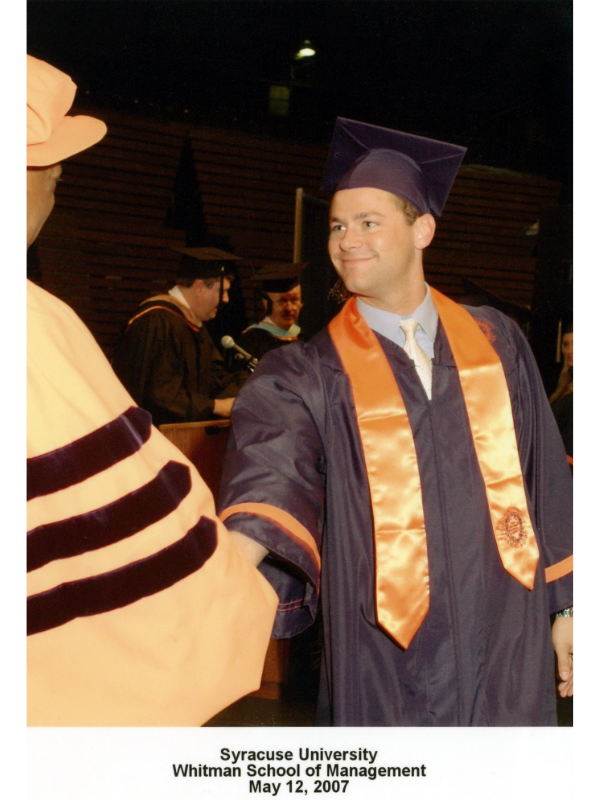
The David M. Herskovits CASSE Fund Scholarship plays a critical role in supporting students, helping ensure that financial barriers do not stand in the way of sustainability-focused education. The scholarship fund was established by the David M. Herskovits Foundation to honor the life of Syracuse alumnus David Herskovits ’07, who became a pioneer in the development and construction of over $1 billion of solar and renewable energy projects before his tragic death at just 38 years old.
“The loss of David inspired us to establish the David M. Herskovits Foundation. Our family’s long, positive association with Syracuse made us want to do something in memory of David that reflected his interests and philanthropy,” says David’s father and fellow Whitman alumnus, Thomas Herskovits ’69, ’71 MBA.
“We have funded an annual scholarship for the past three years to support outstanding Whitman students based on faculty recommendations,” adds David’s mother Rita Herskovits. “Going forward, we will continue to provide meaningful support that enhances the academic journey and leadership development of Whitman students. This reflects our strong commitment to supporting innovative, student-focused initiatives within CASSE. Something we know David would be very proud of.”
Ostrow learned of the award through a faculty nomination. He is grateful for the recognition and the opportunity it represents. "I was honored to learn that I was receiving a scholarship from the Herskovits Scholarship fund. I was also taken by the fact that my interest in the CASSE program is in—sustainability and renewable energy—which is what David Herskovits was passionate about and was actively pursuing before he passed away," says Ostrow.
Looking ahead, Ostrow’s career aspirations have evolved significantly since he began his MBA. Originally interested in traditional manufacturing roles, he is now drawn to the energy sector.
“Everybody needs energy, from poor to rich,” he says. “And how we meet that critical need will shape the future.”
The CASSE program, he says, helped him realize that business and sustainability are not separate pursuits. “The sustainability program has taught me I don’t have to stay within the traditional bounds of business,” Ostrow says. “Business and sustainability go hand in hand.”
By Renée Gearhart Levy